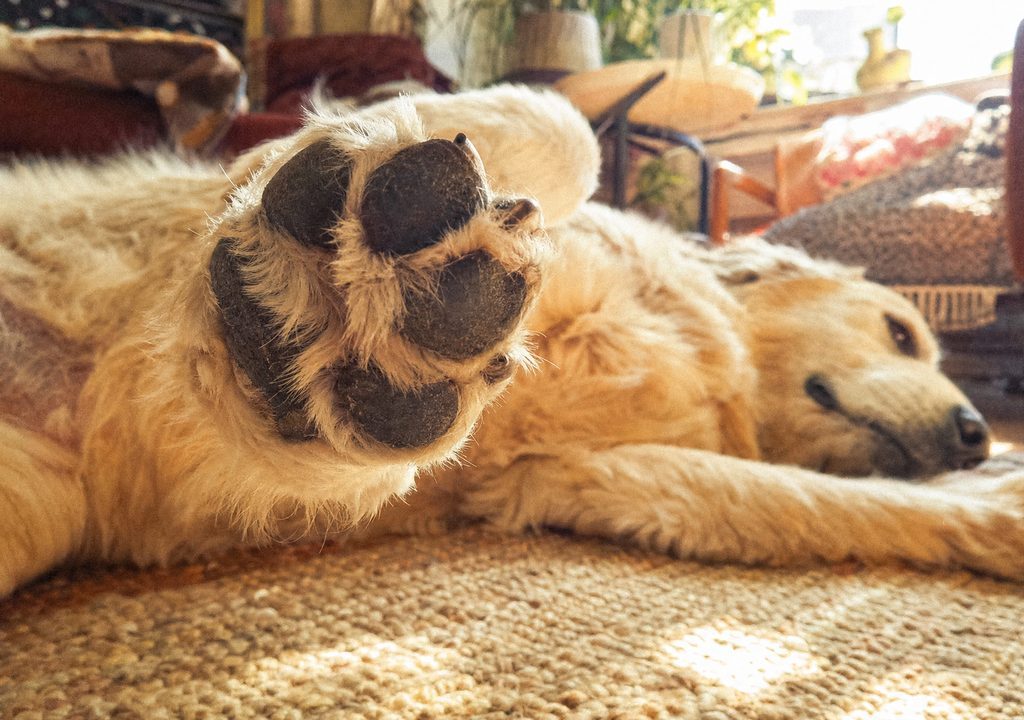
Normal bacteria and yeast living on warm, slightly damp paw skin produce the corn-chip smell. Nobody has actually identified the compound responsible, and the specific bacteria usually blamed are a vet's educated guess rather than a research finding. If your dog isn't licking, limping or red between the toes, the smell alone needs no treatment at all.
I found out about this the way most people do: trimming a nail during an evening cuddle, nose roughly six inches from a paw, getting hit with an unmistakable blast of corn chips. Not "sort of like" corn chips. Fritos, specifically, with confidence.
The internet will tell you exactly which two bacteria are responsible. I'm going to tell you something slightly less satisfying and considerably more honest: nobody actually knows. What we do know is which signs separate a charming party trick from a paw that needs a vet — and that part is genuinely worth your attention. It's the same pattern as what a dog's sleeping position does and doesn't mean: a confident internet answer, and a more useful real one underneath it.
Why It's the Paws and Nowhere Else
You've probably heard that dogs sweat through their paws. That's nearly right, and the detail matters.
Dogs have two kinds of skin gland. Eccrine glands sit in the hairless skin of the footpads and the nose, and open straight onto the surface. Apocrine glands are spread across the rest of the body but empty into hair follicles, and they're not really for cooling — they release pheromones. So the paws and nose are the only places a dog does anything resembling human sweating.
Even then, it's minor. Karen Moriello, a veterinary dermatologist writing for the Merck Veterinary Manual, says these glands may have only a small role in cooling the body. Panting does the real work. Moriello also notes something most articles skip: sebaceous glands — the oil producers — are most numerous near the paws.
Now assemble the environment. Warm skin. A little moisture. Oil. Fur between the toes holding all of it in place. Toes pressed together so air barely reaches the gaps.
Brian Collins, a vet at Cornell's Riney Canine Health Center, describes the result as "a potpourri of bacteria, yeast, and, sometimes, sweat," and points out we find it in exactly the places you'd expect — the feet and the ears. Both are warm, enclosed and slightly damp. Both develop a smell.
Your dog's paws aren't dirty. They're humid.
The Bacteria Everyone Blames
Search this question and you'll get a confident answer: Pseudomonas and Proteus. It's stated as settled fact across hundreds of pages, including some I'd normally trust.
Here's where it comes from. The American Kennel Club published it, attributed to their chief veterinary officer, Dr. Jerry Klein. There's no study behind it and none is cited. Other outlets then quoted the AKC, and the claim hardened into fact through sheer repetition.
To the credit of PetMD, they're straight about this — Jennifer Coates, DVM, calls those two "likely culprits" while noting there hasn't been much research on the question at all.
And when researchers did survey what actually lives on dog skin — a 2014 study in PLoS ONE mapping the canine skin microbiome — the organisms that dominated weren't the ones in the folklore. Different families, different genera entirely.
One organism we can speak about confidently is Malassezia pachydermatis, a yeast. It genuinely does colonise the skin between healthy dogs' toes — that's established, not guessed. Hold onto that name, because it comes back in the section that matters.
Then there's the smell itself. The corn-chip aroma in actual corn chips comes from a compound called 2-acetyl-1-pyrroline, and some bacteria do produce it. Tidy story. Except no one has ever run the analysis on a dog's paw — there's no study identifying any volatile compound coming off canine skin.
Which is a little funny, because we have done exactly that work for a different smell. Pseudomonas aeruginosa's distinctive sweet, grape-like odour was chemically pinned down back in 1979 as 2-aminoacetophenone. Microbiologists use that smell diagnostically. The corn-chip question simply never got the same attention.
Why Some Dogs Reek and Others Don't
It tracks the environment, not the dog's hygiene.
Thick fur between the pads traps more moisture. Humid weather keeps it there. Dogs who swim, walk in rain, or spend real time outdoors reset the damp conditions daily. Breeds with tight interdigital spaces — bulldogs are the classic example — give air even less chance to circulate.
Stress and heat both increase paw sweating, which is why you may notice it more at the vet's office, a place where dogs leave damp pawprints on the exam table.
What it isn't is a cleanliness problem. Meticulously groomed dogs have Frito feet. It's anatomy plus climate plus the ordinary organisms that live on every animal's skin, including yours.
When It Stops Being Frito Feet
This is the part worth reading properly.
The useful signal isn't the smell's strength. It's change, and whether anything else is going on. Heather Edginton, a dermatologist at Cornell's vet school, draws the line clearly: if it's only a smell and nothing else, she wouldn't do anything. What concerns her is a rancid smell, or paws that smelled one way for years and now smell different.
The common troublemaker is that yeast from earlier. A 2022 study in Veterinary Research Communications compared interdigital folds in dogs with pododermatitis against healthy dogs, and the gap was stark — yeast made up over 10% of the fungal community in affected paws versus a fraction of a percent in healthy ones. Treat the dogs, and the load dropped.
But here's the honest caveat, and it's an important one: a review in the Canadian Veterinary Journal states plainly that a yeasty odour is suggestive and should not be used as a diagnostic criterion without cytology. Healthy and affected dogs overlap. You cannot diagnose a paw by sniffing it, and neither can I.
Infected paws usually come with a cast of other signs. Amy Attas, VMD, describes yeast dermatitis odour as sour milk, with greasy brown discharge, hair loss, and skin that thickens and darkens over time. She also flags that discomfort may be the first thing you notice, before anything looks obviously wrong.
| Ordinary Frito feet | Worth a vet visit |
|---|---|
| Corn chips, popcorn, slightly yeasty | Rancid, sour milk, or "moldy cheese" |
| Smelled this way for years | Changed recently, or got much stronger |
| Skin between toes looks normal | Redness, swelling, lumps, discharge |
| Dog ignores their feet | Constant licking, chewing or biting |
| Walking normally | Limping, or flinching when you touch a paw |
One piece of terminology to retire while we're here. Those painful swellings that form between the toes get called "interdigital cysts" constantly. Merck's dermatology chapter notes they're almost never cystic — they're furuncles, a deep reaction to hair pushed into the skin. The name matters because it shapes how seriously people take them, and they hurt.
What to Do (and What to Skip)
Start here: for a healthy dog with smelly feet and no other symptoms, the correct amount of intervention is none. Edginton and Klein independently land in the same place — if the dog isn't bothered, it isn't a problem.
If you want to reduce it anyway, these are the sourced, sensible options:
- Dry between the toes after walks, swimming or rain. This is the one step every credible source agrees on. Soft towel, gently, actually get into the gaps.
- Wipe rather than wash for routine cleaning. The AKC suggests unscented, alcohol-free wipes — they lift dirt while leaving normal skin flora alone. Save full washing for mud or worse.
- Trim the fur between the pads so air can reach skin. One caveat from Merck: if there are already sores, use scissors rather than clippers, which can drive hair into the skin.
- Rinse properly if you do wash. Edginton's emphasis — leftover shampoo residue causes its own problems.
And what to skip. Edginton warns specifically against messing with the skin's pH by applying products, which is the problem with most home remedies circulating online. Vinegar and apple cider vinegar soaks are exactly that kind of pH disruption, and I couldn't find a single veterinary source supporting them — only affiliate blogs. Epsom salt soaks have no evidence base either direction, and dogs lick their feet, so anything you soak them in gets eaten.
Hydrogen peroxide is the one to actively avoid: Pet Poison Helpline warns that applying it to skin or wounds can cause irritation or chemical burns.
Skip the scented paw sprays too. They mask a smell that was telling you something, and your dog's nose is considerably better than yours.
When to Call Your Vet
Book an appointment if you see any of these alongside the smell:
- The smell changed — stronger, or rancid rather than corn-chip
- Licking or chewing at the paws that won't stop
- Redness or swelling between the toes or on the pads
- Lumps, sores, or discharge, especially on the top of the paw
- Limping, or pulling the foot away when touched
- Hair loss or thickened, darkened skin around the pads
Worth knowing: these infections rarely clear up on their own, and recurring paw problems are often downstream of something else — allergies being the usual culprit. Treating the paw without finding the cause means doing it again in two months.
Your vet can settle in minutes what no amount of sniffing will, by taking a sample and looking at it under a microscope.
Frequently Asked Questions
Do all dogs get Frito feet?
Most dogs have some version of it, because every dog has the same warm, slightly damp paw skin and the same ordinary flora living on it. How noticeable it gets depends on paw fur, climate and how much time your dog spends wet.
Is Frito feet contagious to other dogs or people?
No. These are organisms that already live on normal skin - yours included. You are not going to catch corn-chip feet from your dog, and your dog did not catch it from another dog.
Can I use human foot powder or deodorant on my dog's paws?
Don't. A Cornell dermatologist specifically warns against disrupting the skin's pH with products, and anything you put on a paw gets licked off and swallowed. If the smell bothers you that much, dry between the toes instead.
Does the smell mean my dog needs a bath?
Usually not. Frito feet isn't a dirt problem - very clean dogs have it too. Wiping paws after walks does more than bathing, and over-washing can strip the skin and make things worse.
Why does it smell stronger in summer?
Heat and humidity both increase paw sweating and keep moisture trapped between the toes for longer. Swimming season adds to it. Same dog, same bacteria, better conditions.
Article Sources
- Hoffmann, A. R. et al. "The skin microbiome in healthy and allergic dogs." PLoS ONE, 2014 — full text.
- Díaz, L. et al. "Study of the variation of the Malassezia load in the interdigital fold of dogs with pododermatitis." Veterinary Research Communications, 2022 — full text.
- Bajwa, J. "Malassezia species and its significance in canine skin disease." Canadian Veterinary Journal, 2023 — full text.
- Cox, C. D. & Parker, J. "Use of 2-aminoacetophenone production in identification of Pseudomonas aeruginosa." Journal of Clinical Microbiology, 1979 — full text.
- Moriello, K. A., DVM, DACVD, "Structure of the Skin in Dogs" and "Interdigital Furunculosis in Dogs," Merck Veterinary Manual.
- Jennings, R. & Premanandan, C., Veterinary Histology, Ohio State University.
- Drs. Brian Collins and Heather Edginton, Cornell University College of Veterinary Medicine, quoted here.
- Jennifer Coates, DVM, PetMD; Amy Attas, VMD, on yeast dermatitis; Jerry Klein, DVM, AKC.
- Pet Poison Helpline, "Is Hydrogen Peroxide Harmful to Dogs?"
This article is general information, not veterinary advice. A smell you can't explain, or a dog who won't leave their feet alone, is worth an actual examination.
So go smell your dog's feet. You have my blessing, and now you can tell anyone who asks that the famous two-bacteria explanation is a well-dressed guess. Just check the skin between the toes while you're down there — that's the part that actually tells you something.
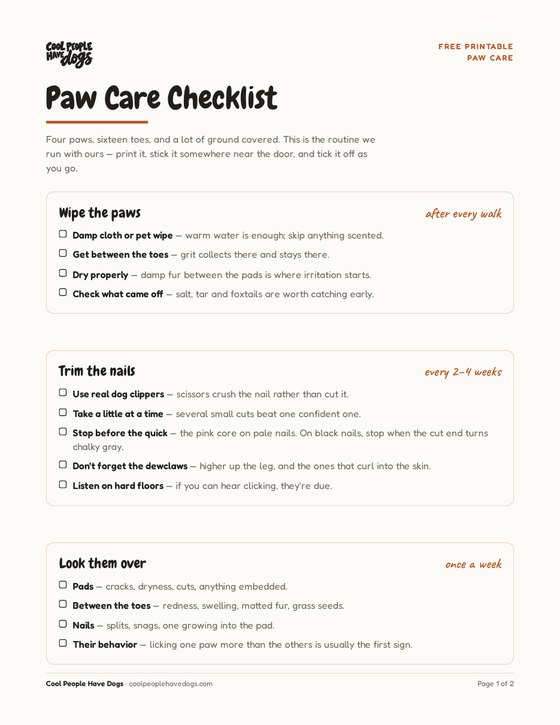
Grab the free At-Home Paw Care Checklist.
A printable routine for wiping, trimming, and checking paws — including the exact fix for Fritos feet from this article.