Resting an older dog is outdated advice — it costs them muscle, weight control and mobility. What they need is low-impact activity little and often, on grass or carpet rather than slick floors, with no jumping down from anything. Scent games give the most engagement for the least joint load.
The instinct when a dog slows down is to let them rest. It's kind, and it's the wrong move.
Canine arthritis specialists now name exercise restriction explicitly as outdated advice, because it drives weight gain, stiffness and muscle loss — each of which makes the next month harder. The goal isn't less movement. It's different movement, and a lot more thinking — most of which works just as well indoors on a wet afternoon.
Here are fifteen games built for that, plus the ground rules worth getting right first.
The Ground Rules
Before any game, these matter more than which one you pick:
- Little and often. Thirty to sixty minutes spread across the day beats one long weekend outing, which is the pattern most likely to leave a dog sore.
- Grass and carpet, not tile or hardwood. Slippery floors are the most common home hazard for a stiff dog. Rugs, yoga mats or gym tiles with non-slip backing — including under their bed, where they push off to stand.
- No jumping down. Off beds, off the sofa, out of the car. Descent loads the front legs hardest. Ramps or steps, or lift them.
- Nails short, paw hair trimmed. Traction starts at the feet. Monthly trims make a visible difference to confidence on smooth floors.
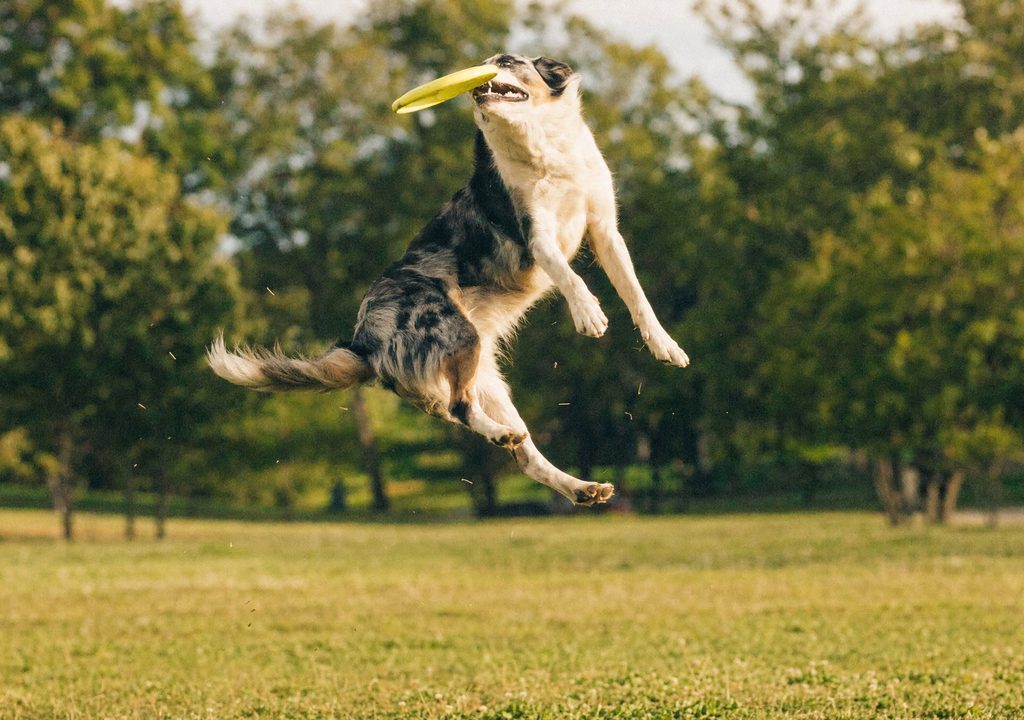
- No repetitive fetch, no frisbee, no jumping to catch. These are specifically on the avoid list for arthritic dogs.
- Judge the next morning. Soreness often shows up later, not during. If they're stiffer the following day, that session was too long.
Nose Games (The Best Option)
Scent work is explicitly recommended for arthritic dogs, and it's the one activity with real mood evidence behind it.
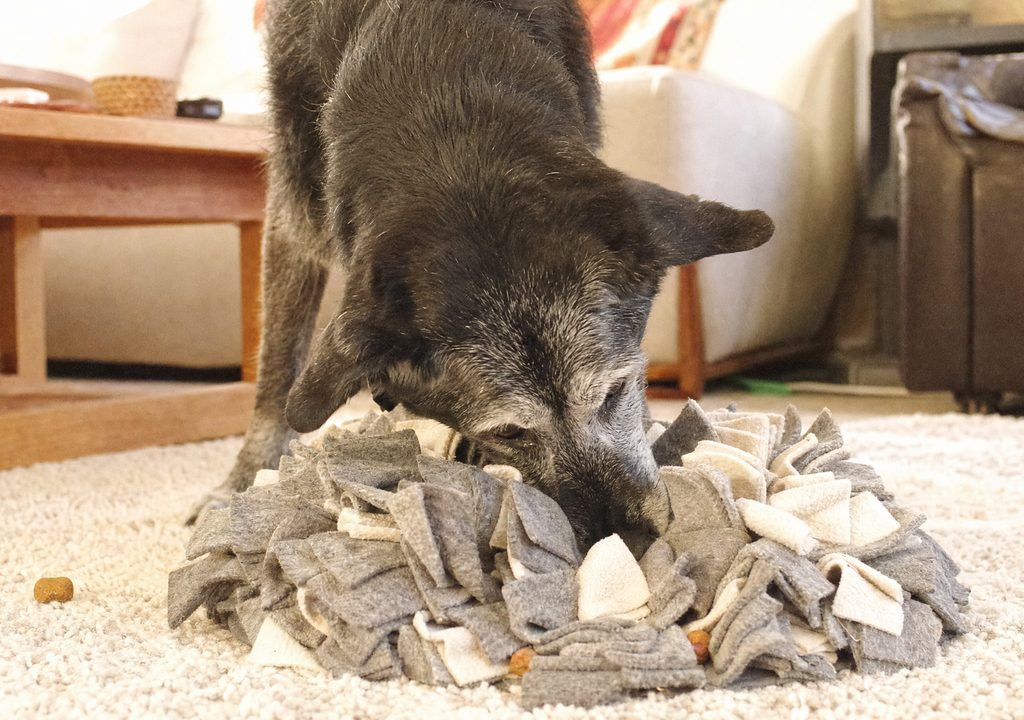
1. Snuffle mat or scatter feeding. A meal spread into fabric strips or across a rug. Zero joint load, full engagement. Use a mat or rug, never tile.
2. Raised find-it boxes. The same search game, but with the boxes on a low stool or step rather than the floor. This small change removes the repeated neck and elbow flexion of nose-to-floor searching, which matters a lot for a dog with neck or elbow arthritis. Almost nobody mentions this and it's the single best adaptation here.
3. Formal scent discrimination. One target odour on a cotton swab, hidden among several containers, short searches. Self-paced, genuinely absorbing, and completely unchanged by failing eyesight or hearing.
4. Flat lawn food trail. A short dragged trail across the grass with a jackpot at the end. Nose work plus a few metres of slow, deliberate walking.
5. Sniffari walk. A long line on a harness, and your dog chooses the route and the pace while you follow. This keeps the daily walk without the distance or speed. Trails and varied ground are better than pavement — just keep off gravel and anything slick.
Games They Can Play Lying Down
6. Which hand. Treat in one fist, they nose the right one. Full engagement, no movement at all. The best option for a dog on crate rest or a very stiff day.
7. Three-cup shell game. Played on the floor in front of them while they stay lying down. Real cognitive work at zero physical cost.
8. Muffin-tin puzzle. On the floor or a low step. If arthritis limits how well they use their paws, use fewer balls so it stays solvable.
9. Graduated puzzle feeders. A rotating set of two or three commercial puzzles. One caution that matters: if your dog has cognitive decline, step the difficulty down. A puzzle a confused dog can't solve produces frustration, not enrichment.
10. Nose-touch targeting. They touch your hand or a target stick on cue. Low-impact, gives a sore dog a way to earn rewards without moving much, and later becomes a steering tool if their sight fades.
11. Chin rest and cooperative care. Teaching them to rest their chin in your palm and hold still for handling, nail trims and eye drops. This gets more valuable every year as medication and vet visits increase — it turns handling from something done to them into something they participate in.
Gentle Moving Games
12. Ground-level cavaletti. Broom handles laid flat on the grass, walked slowly. Encourages deliberate limb placement, which degrades with age. For seniors, flat on the ground — no height at all.
13. Cookie stretches and sit-to-stands. Luring the head slowly toward each hip and to the chest, and controlled sit-to-stand repetitions. These are real therapeutic exercises with some evidence for improving range of motion. Ask your vet or a veterinary physiotherapist to prescribe the reps — the physiotherapy literature specifically warns against untrained owners doing joint mobilisation, and against balance boards and wobble cushions.
14. Swimming or underwater treadmill. The one way to load muscle hard with almost no joint impact, and the canine arthritis exercise finding with an actual measured outcome behind it. Vet clearance first, buoyancy aid, and watch for fatigue — it arrives suddenly in older dogs. Flat-faced and short-legged dogs are poor swimmers.
15. Novelty outings. A café sit, a wander round a garden centre, a short drive somewhere new and quiet. Store and café outings are on the recommended list for arthritic dogs, and new sights and smells are enrichment that costs the joints nothing. Often the best value-per-effort on this page.
If Sight or Hearing Is Going
Losing vision: switch to toys that squeak, crackle or smell. Throw a toy hard and close so they hear it land, then let them track it by nose. Smear a chew with peanut butter so it carries scent. Useful cues: a shoulder tap for "turn toward me," plus "step up," "step down" and "careful." Wear something that jingles so they can locate you, and keep routes predictable.
Losing hearing: stomp the floor to get attention rather than startling them awake with a touch. A shoulder tap becomes "look at me." A thumbs-up replaces the clicker. Hand signals work for sit, down, stay and come. A vibrating — never shock — collar gets attention at distance for some dogs. Keep them on lead unless the space is securely fenced.
Scent games work identically either way, which is part of why they're first on this list.
Signs It's Too Much
- Refusing a walk, sitting down, or resisting the lead
- Stiffness or difficulty rising, especially the morning after
- Limping after activity, even mild
- Whining during exercise
- Struggling with stairs or moving around the house more than usual
- Losing weight or struggling to hold it after increasing activity
Any activity that makes lameness worse is too much. And it's worth saying: slowing down is not automatically "just age." Arthritis is treatable, and a lot of what owners accept as inevitable turns out to be manageable pain. A vet visit before you redesign their routine is the right order to do this in.
The encouraging part is that mental work seems to matter. A study of 185 pet dogs found that lifelong training appeared to delay the ageing of attentiveness — trained dogs held attention longer and made eye contact faster. The same group later found no effect on discrimination learning, so this isn't a cure-all. But the attention finding is real, and keeping an old dog thinking costs nothing.
Frequently Asked Questions
Should I let my old dog rest more?
Canine arthritis specialists now name exercise restriction as outdated advice - it drives weight gain, stiffness and muscle loss. What changes isn't the amount of movement so much as the kind of movement: low-impact, little and often, on non-slip surfaces.
What's the best game for an arthritic dog?
Scent games. They're explicitly recommended for dogs with osteoarthritis, they cost the joints nothing, and they work unchanged if sight or hearing is fading. Raising the search boxes onto a low stool also saves a lot of neck and elbow flexion.
How do I know if I've done too much?
Judge the morning after, not the moment. Stiffness, difficulty rising, limping or reluctance on the next walk all mean that session was too long. Any activity that makes lameness worse is too much.
Can I do physiotherapy exercises at home?
Simple things like cookie stretches and sit-to-stands have some evidence behind them, but ask your vet or a veterinary physiotherapist to prescribe the repetitions. The physiotherapy literature warns specifically against untrained owners performing joint mobilisation, and against balance boards and wobble cushions.
Does mental stimulation help an ageing dog's brain?
It looks that way for attention. A study of 185 pet dogs found lifelong training appeared to delay the ageing of attentiveness. A follow-up found no effect on discrimination learning, so it isn't a cure-all - but keeping an old dog thinking costs nothing.
My dog is going blind. Can we still play?
Yes, and scent games need no adaptation at all. For toy games, use squeaky or scented toys and throw them close so your dog hears them land. Wearing something that jingles helps them locate you.
Article Sources
- Mille, M. A., McClement, J. & Lauer, S. "Physiotherapeutic Strategies and Their Current Evidence for Canine Osteoarthritis." Veterinary Sciences, 2022 — full text.
- Canine Arthritis Resources and Education, Dr Kristin Kirkby Shaw, "Lifestyle modifications for dogs with OA."
- Chapagain, D. et al. "Aging of Attentiveness in Border Collies and Other Pet Dog Breeds: The Protective Benefits of Lifelong Training." Frontiers in Aging Neuroscience, 2017 — full text.
- Chapagain, D. et al. "Effect of Age and Dietary Intervention on Discrimination Learning in Pet Dogs." Frontiers in Psychology, 2018 — full text.
- Duranton, C. & Horowitz, A. "Let me sniff! Nosework induces positive judgment bias in pet dogs." Applied Animal Behaviour Science, 2019 — summary.
- BC SPCA, "Is my dog getting too much exercise?"
- Toronto Humane Society, "Training and Enrichment of Blind and Deaf Dogs."
This article is general information, not veterinary advice. Get a diagnosis before building a routine around what you think is going on.
Put a rug down where your dog gets up from their bed, and try the raised find-it boxes this week. Two small changes, and you'll likely see a difference in how easily they stand up by the weekend.
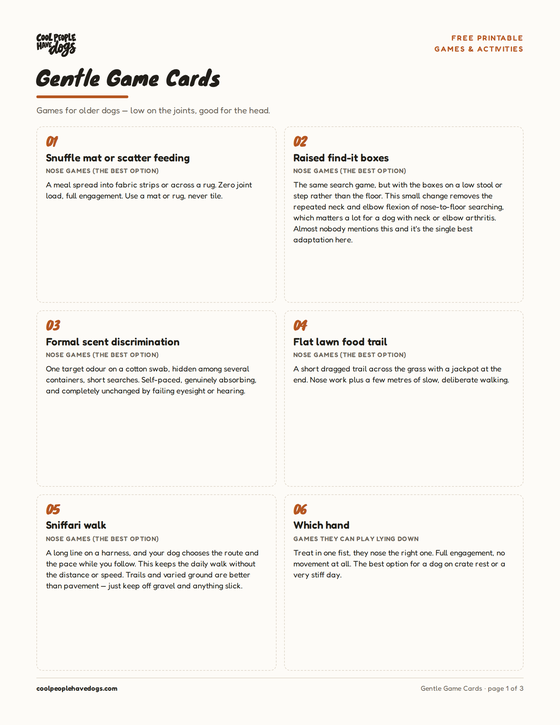
Grab the free gentle game cards.
15 low-impact games as printable cards — plus new game guides as they're published.
Which game still works for your senior dog?
Five questions about what your older dog can comfortably do. Slowing down physically doesn't mean slowing down mentally.
5 questions · no email needed
How's their mobility?
What about hearing and sight?
What did they love most when they were younger?
How's their appetite?
What's the problem you're trying to solve?
Scent Games
Stiff, with hearing and sight fading, and seeming flat - scentwork is almost made for this dog. Smell is the last sense to go and often stays sharp long after the others dull, so a nose game is something they can still be good at, which matters more than it sounds. Hide food in a snuffle mat or under folded towels at floor level, no turning or standing required.
Fetch, Scaled Down
A lifelong fetch dog with decent movement and no stamina doesn't need the game taken away, just shrunk. Roll the ball rather than throwing it, keep it on carpet or grass for grip, and stop after a handful of retrieves rather than waiting for them to flag - they won't tell you. The joy is in the retrieve itself, not the distance.
Food Puzzles and Problem-Solving
Physically sound, sharp, extremely food-focused, with energy and nowhere to put it - this dog wants something to think about. Puzzle feeders, shell games, and teaching something genuinely new all work, and there's decent evidence that mental work helps hold off cognitive decline. Difficulty is the point; make it harder than you'd assume.
Let the Walk Be About the Nose
When walks get too short to feel satisfying, the usual mistake is covering the same ground faster. Do the opposite: go somewhere new and let them set the pace entirely, stopping as long as they like at everything. A hundred metres of genuinely interesting ground does more for an older dog than a brisk kilometre, and it costs their joints almost nothing.