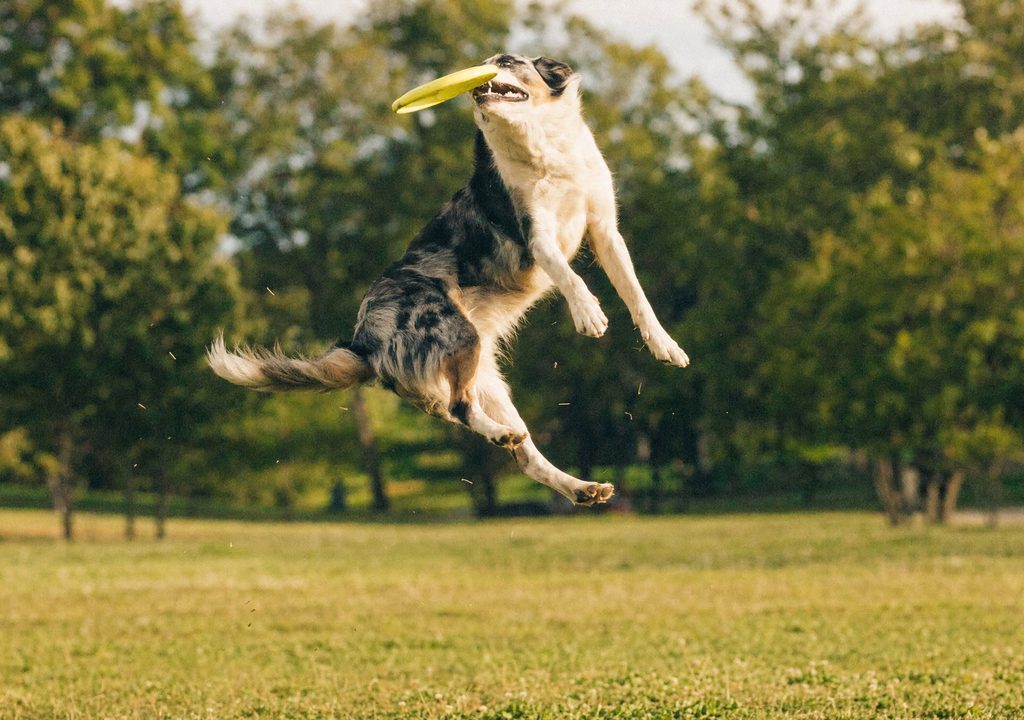
For a genuinely high-energy dog, repetitive ball-chucker fetch is the worst option, not the best — it's the one activity with research linking it to joint disease. Swap it for chase games where the dog isn't braking hard, and pair every physical game with a thinking game. Mental work produces the calm that running usually doesn't.
If you have one of these dogs you already know the problem. You walk them for an hour, throw the ball until your shoulder aches, and they come home and stare at you like you've done nothing.
Here's what I'd change. The ball-throwing is probably part of the problem, and the exhaustion you're chasing more reliably comes from their nose and their brain than their legs. Below are fifteen games that work, with the specific reasons each one is on the list — and the safety flags that come with the riskiest ones. If the constraint is the weather or the space rather than the dog, there are versions of this list for a day stuck indoors and for a yard with no run-up.
Chase Games That Don't Wreck Joints
The chase instinct is real and worth feeding. The trick is removing the hard stop at the end.
1. Flirt pole. A lure on a line on a pole. You sweep it along the ground, your dog chases and catches, you trade for a treat. It delivers the entire predatory sequence — eye, stalk, chase, grab — in a space the size of a living room rug, and the output per minute is enormous. Keep the lure on the ground. Sweeping it overhead makes dogs leap and twist, which is how stifles and shoulders get hurt. Skip it for dogs under a year, and for any dog who can't let go on cue.
2. Uphill-only fetch. Throw up a slope; your dog walks back down. Same game, far more cardiovascular cost per throw, and almost none of the skidding stops that make flat fetch risky. If you only change one thing on this page, change this.
3. Two-toy fetch. Throw toy A. The moment your dog turns, show toy B and call. Swap, repeat. It keeps the drive of fetch, trains recall and trading at the same time, and lets you cap the number of reps instead of going until someone gives up.
4. Restrained recall relay. Two people, thirty metres apart. One holds the dog by the harness while the other calls. Release, sprint, reward, reverse. Full-speed straight lines with no hard braking, and your recall gets better every rep.
5. Spring pole. A tug toy on a bungee hung from a branch or beam, so your dog can play tug alone. Self-directed, builds grip and rear-end strength, and they control the intensity. Hang it so their feet stay on the ground. Not for puppies.
6. Sprinkler or hose chase. An oscillating sprinkler gives them something to chase that never quite ends, with no object to catch and no sudden stop. Stop if your dog can't disengage — a few become genuinely obsessive about water jets.
7. Canicross or bikejor. Your dog pulls ahead in a harness while you run or ride. The highest-volume aerobic option there is, with no stop-start loading at all. Fully grown dogs only — 18 to 24 months in big breeds — and get a vet check first.
Nose and Hunting Games
8. Dragged scent trail. Drag a food-scented sock fifty to a hundred metres across a field, hide a jackpot at the end, release your dog. Sustained movement plus hard nose work. This tires most dogs faster than walking the same distance.
9. Barn-hunt style tube search. Hide a scented tube in a maze of cardboard boxes or straw bales and let them hunt. Sniffing, climbing and burrowing at once. Terriers in particular find this exhausting in the best way.
10. Dig pit. A sandbox or child's paddling pool filled with sand, with toys buried in it. Digging is powerfully self-reinforcing, burns real energy, and this is the difference between a channelled behaviour and a destroyed lawn.
11. Paddling pool bobbing. Floating toys and treats in a few inches of water. Cooling, low-impact, and completely novel for most dogs. The best hot-weather option on this list.
Brain Games That Actually Tire Them
12. Shaping sessions. Ten minutes of free-shaping — marking and rewarding tiny steps toward a new behaviour, like circling a cone or putting two paws in a box. Most high-energy dogs are under-stimulated rather than under-exercised. Concentrated problem-solving produces a calm, genuine tiredness that running rarely does. Pair this with any physical game above and you'll notice the difference the same evening.
13. Treibball. Your dog learns to nose-push large exercise balls toward a goal. Herding-breed catnip: physical and cognitive at once, no impact loading, works in a small space. It takes real training to build the first push, which is part of the appeal.
14. Canine parkour. Cue your dog onto, under, over and through safe real-world objects — benches, logs, low walls. Body awareness, confidence, problem-solving, and you set the intensity. Keep heights at or below elbow height and never let them jump down.
15. Named-toy retrieval. Teach toy names one at a time, then send them to fetch by name from a pile. A project that scales for months. It's the closest a pet dog gets to learning language, and it's genuinely hard work for them.
What Actually Tires a Dog Out
Three things worth knowing, because they contradict a lot of popular advice.
There is no evidence-based number for how much exercise a dog needs. A 2025 study tracked around 28,500 dogs on activity monitors and found a mean of roughly 51 active minutes a day — with individuals ranging from under ten minutes to over six hundred. The authors were explicit that this describes what dogs do, not what they require. Every "two hours for working breeds" chart you've seen is convention, not research.
Sniffing isn't calming — it's engaging. This surprised me. A 2026 study put companion dogs in ECG halters during scent work and found heart rate was highest during the search, higher than on a control walk. Scent work looks like positive, engaged arousal rather than relaxation. It's still worth doing: a 2019 study found two weeks of nosework training made dogs measurably more "optimistic" on a judgement-bias test, where a matched heelwork group didn't change. Just don't expect it to switch your dog off.
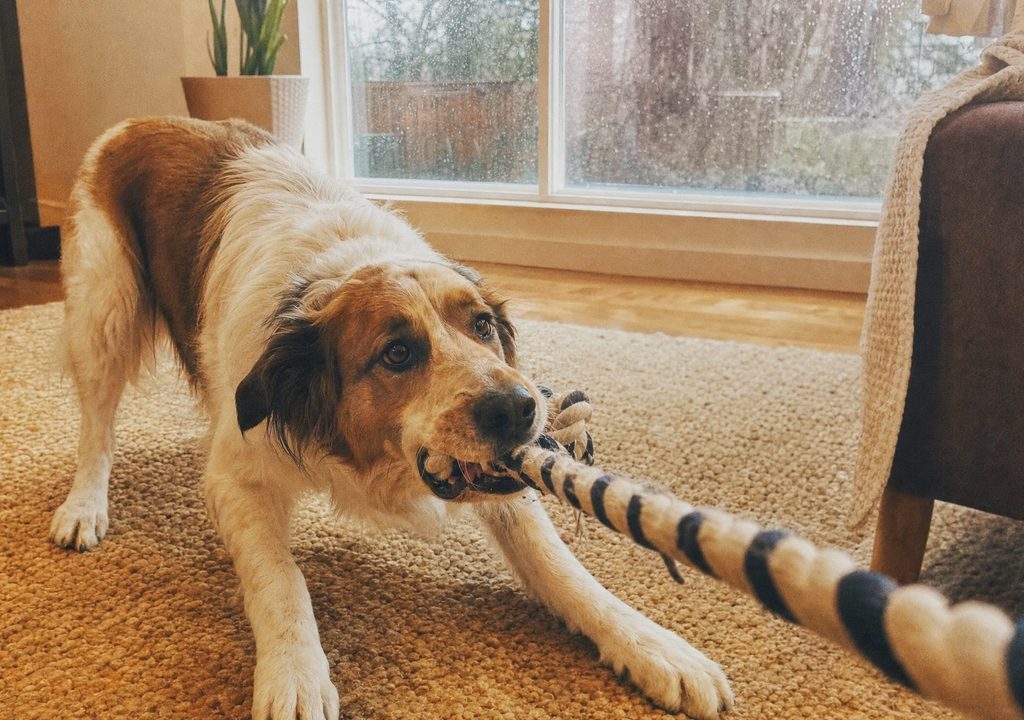
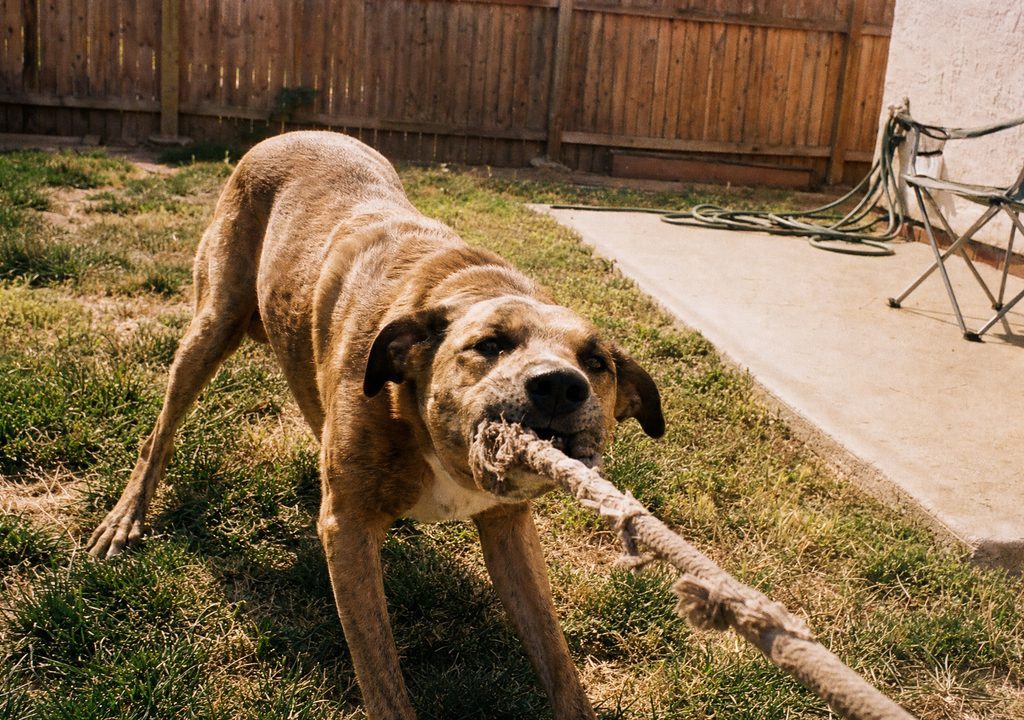
Tug does not make dogs dominant. This myth refuses to die. Researchers ran Golden Retrievers through twenty tug sessions they were allowed to win and twenty they lost. Whether the dog won or lost had no effect on the dominance-related measure — and dogs were more attentive and obedient after playing, either way. Play tug. Let them win sometimes.
One honest caveat on toys: a 2023 study gave dogs twelve days of ordinary retail enrichment toys and found no improvement in activity, food intake or mood. Only the more complex puzzles moved the needle slightly. Buying toys isn't enrichment. Using them is.
What to Stop Doing
Repetitive ball-chucker fetch. This is the best-supported warning here. A systematic review of osteoarthritis risk factors records running after balls or sticks as associated with roughly 2.4 times the odds of dysplastic joint disease. The mechanism is obvious once you watch it in slow motion — the sprint, the hard brake, the twist, the mid-air catch, forty times in a row. Throw fewer, throw uphill, or switch to the two-toy version.
Throwing sticks. Oropharyngeal stick injuries happen when a dog runs onto a stick that's planted at one end. The reported consequences include retained wood causing abscesses, perforated oesophagus, soft-palate tears and eye injuries. It's not common, but it's bad enough that there's no reason to keep doing it when a toy costs five pounds.
Laser pointers. Worth being precise here: the study showing a link between laser play and compulsive light-chasing was in cats, not dogs, and it was correlational. There's no equivalent dog study. But the mechanism — a chase that can never, ever be completed — is sound enough, and light-chasing compulsions in dogs are a real clinical problem. Use a flirt pole instead; it ends with a catch.
And one claim to ignore entirely: you'll read that stress hormones from over-arousal circulate for "up to 40 days." There's no study behind that number and it isn't physiologically plausible. The sensible version of that advice — don't let a dog live in a state of constant frantic arousal — stands on its own without the invented statistic.
Frequently Asked Questions
Will more exercise calm my hyper dog down?
Not reliably. There's no study behind "a tired dog is a good dog," and trainers widely report that daily repetitive chasing raises a dog's baseline arousal rather than lowering it. Mental work - shaping, scent games, puzzles - tends to produce calmer evenings than another mile.
How much exercise does my dog actually need?
Nobody knows, and any breed chart claiming otherwise is convention rather than research. A 2025 study of around 28,500 dogs found an average of roughly 51 active minutes a day, with individuals ranging from under ten minutes to over six hundred. Work from your own dog.
Is tug of war bad for dogs?
No. The idea that letting a dog win makes it dominant was tested directly and failed - winning or losing made no difference to dominance measures, and dogs were more attentive and obedient after playing either way.
Is fetch actually bad for my dog?
Repetitive hard-braking fetch is. A systematic review links running after balls or sticks to roughly 2.4 times the odds of dysplastic joint disease. Throwing uphill, using two toys, and capping the reps keeps the game without the worst of the loading.
What age can my dog start a flirt pole?
Wait until they're fully grown - around twelve months for most dogs, longer for large breeds. Keep the lure on the ground rather than overhead, because jumping and twisting mid-air is where injuries happen.
Article Sources
- Anderson, K. L. et al. "Risk Factors for Canine Osteoarthritis and Its Predisposing Arthropathies: A Systematic Review." Frontiers in Veterinary Science, 2020 — full text.
- O'Rourke, A. et al. "Estimated activity levels in dogs at population scale." Frontiers in Veterinary Science, 2025 — full text.
- Duranton, C. & Horowitz, A. "Let me sniff! Nosework induces positive judgment bias in pet dogs." Applied Animal Behaviour Science, 2019 — summary.
- Fountain, J. et al. "Heart rate variability and behaviour in dogs during and after scent work." Applied Animal Behaviour Science, 2026 — record.
- Rooney, N. J. & Bradshaw, J. W. S. "An experimental study of the effects of play upon the dog–human relationship." Applied Animal Behaviour Science, 2002 — record.
- Chan, K., Arellano, C. & Horowitz, A. "Here puppy, chew on this: short-term provision of toys does not improve welfare in companion dogs." Animals, 2023 — record.
- Shales, C., "Acute oropharyngeal stick injuries in canine patients," Vet Times.
- Kogan, L. R. & Grigg, E. K. on laser play and repetitive behaviour (in cats), Animals, 2021 — full text.
This article is general information, not veterinary advice. Check with your vet before starting a new activity with a growing, elderly or already sore dog.
Try this for a week: cut your fetch reps in half and add ten minutes of shaping or a scent trail in their place. Most people are startled by how much better the evenings get.
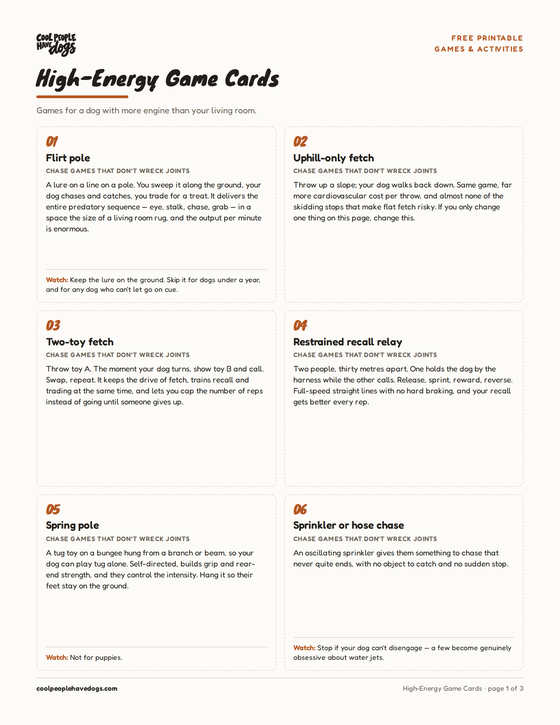
Grab the free game cards.
All 15 games as printable cards to keep on hand — plus new game guides as they're published.
Which high-energy game will actually tire your dog out?
Five questions about what your dog is built for. Thirty minutes of the right game beats an hour of the wrong one.
5 questions · no email needed
What does your dog do with a thrown ball?
What breed group are they, roughly?
After a long walk, what are they like?
How much space do you have for this?
What ends a session badly?
Fetch, With Rules
You have the classic retrieving dog, and the risk isn't boredom, it's overuse - repetitive high-speed fetch is hard on joints and some dogs will run themselves into injury rather than stop. Keep it, but cap it: fewer throws, built-in pauses, and a sit before each one. Adding a search element - throw it into long grass so they have to find it - tires them far more per throw.
Flirt Pole and Impulse Work
A herding dog that finishes a long walk physically fine and mentally buzzing needs a job, not more distance. Chase games with a clear start and stop - a flirt pole, two-toy swaps - give the motivation an outlet while practising the off switch, which is the actual problem. Pure uncontrolled chasing makes the franticness worse; chase with rules fixes it.
Tug, Properly Structured
Grab-and-shake with a terrier or bully type means tug is the natural outlet, and the old advice that it makes dogs aggressive has not held up - structured tug with a reliable release is one of the best games available. The structure is the whole point: they take it on cue, let go on cue, and the game restarts. Escalation is a sign the rules have slipped, not that tug is wrong.
Scentwork
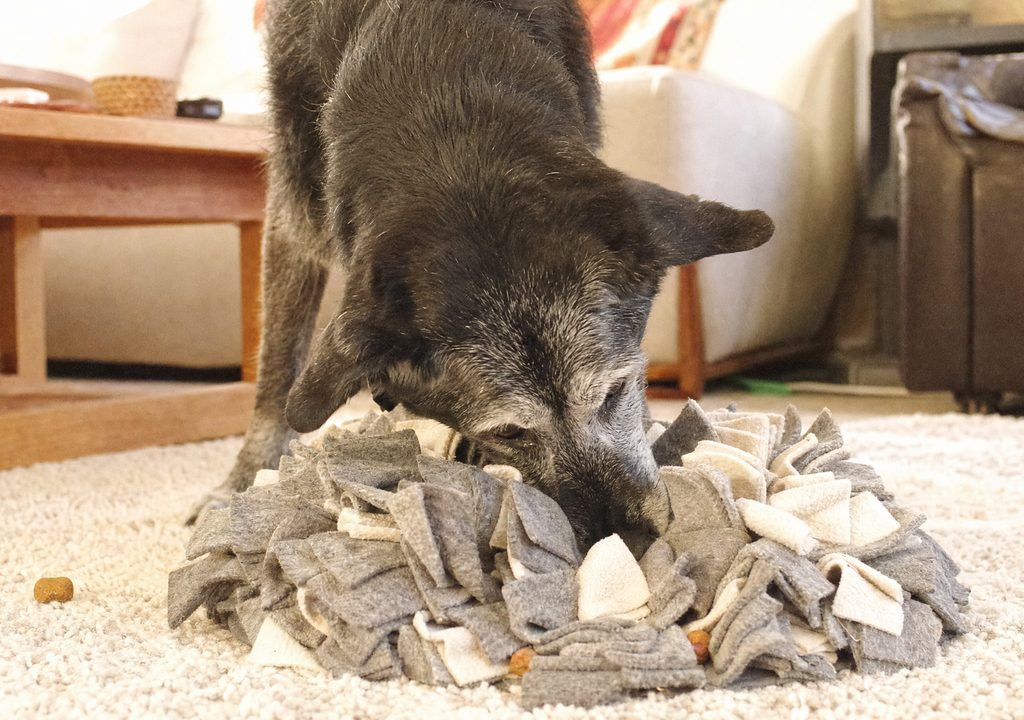
A dog who abandons the ball to go sniffing and comes home properly tired from interesting ground is telling you exactly what to invest in. Scentwork is the most efficient tiring activity there is - twenty minutes of searching beats an hour of walking - and it works in any amount of space, at any age, in any weather. Start by hiding food, then move to a specific toy.