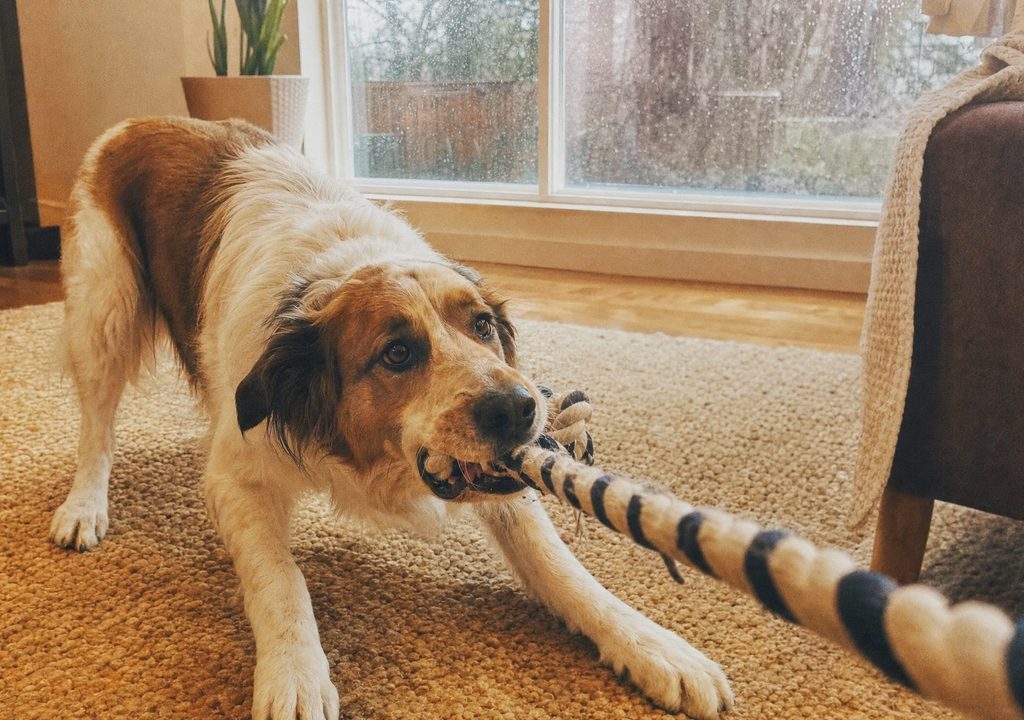
You can't replace a walk with laps of the hallway, but you don't need to. Indoors, mental work does the job physical exercise does outside — searching, problem-solving and shredding. Most of the games below cost nothing and use things already in your recycling.
Rain all day, a dog who has noticed, and a hallway that is not a field. It's a familiar standoff.
The good news is that a dog who's spent twenty minutes genuinely thinking is usually more settled than one who's run three miles — which is as true of a dog with a real engine on them as it is of any other. These are fifteen indoor games worth having in your back pocket, roughly in order of how little effort they take to set up.
Zero-Setup Games
1. Which hand. Treat in one closed fist, both offered, your dog nose-touches the right one. You can play this from the sofa without putting your tea down. Good for impulse control, and one of the few games that works just as well for an old or sore dog.
2. Hide and seek. Ask for a wait, go hide somewhere in the house, call once. They find you. It rehearses recall, uses scent and problem-solving, and the payoff — finding you — is more motivating than most food games.
3. Kibble scatter. Throw a handful of their dinner across a rug and let them hoover it up. Thirty seconds of effort, ten minutes of nose-down foraging. Use a rug rather than a hard floor so they aren't scrabbling.
4. Ready, steady, go. Build anticipation while they hold a sit, then release them to a tossed treat on a cue word. This trains the off-switch under excitement, which is the exact skill most dogs lack on a frustrating indoor day.
5. Trick stacking. Spin, bow, back-up, crawl, paws-up, chin rest — taught one at a time, then chained. Back-up and crawl in particular build core strength and body awareness, and it all reads as play rather than training.
Games From Your Recycling
6. Muffin-tin puzzle. Treats in the cups, tennis balls on top. This is the first puzzle most dogs ever solve, and it scales — add more balls, or move to a twenty-four cup tin.
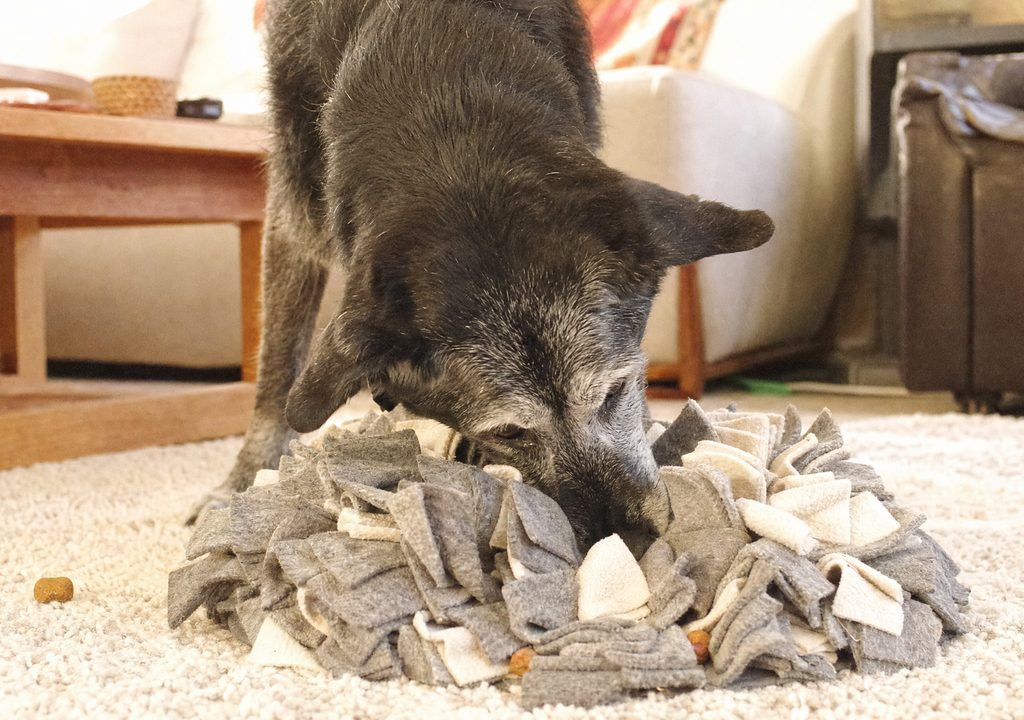
7. Towel roll. Scatter kibble along a bath towel, roll it up, hand it over. A free snuffle mat that takes ten seconds to build and works nearly as well.
8. Cardboard tube treat log. Treats inside a kitchen roll tube, ends folded in. For a dog who solves it instantly, nest a smaller tube inside a bigger one. Free, endlessly repeatable, and it teaches persistence.
9. Box bonanza. A cardboard box loosely packed with crumpled paper, empty tubes and hidden treats. Licensed destruction, which satisfies a real instinct that most house dogs never get to use. Supervise it — some dogs swallow cardboard rather than just shredding it.
10. Lidded containers. Treats in a Tupperware with the lid balanced on top, or nested containers to work through. Teaches a nose-and-paw strategy. Nothing small enough to swallow.
Proper Thinking Games
11. Three-cup shell game. Treat under one of three upturned cups, shuffle, let them indicate which. Unlike most "puzzles," this one genuinely requires tracking rather than sniffing, and you can make it properly hard.
12. Scent discrimination. Put a drop of a single scent — birch, clove, peppermint — on a cotton swab, pair it with food a few times, then hide it in one of six boxes. This is the on-ramp to actual nosework, and it's the one activity on this page with real mood research behind it. It also works completely unchanged for a blind or deaf dog.
13. Named-toy retrieval. Teach one toy's name properly, then a second, then send them to fetch by name from a pile. A project you can run five minutes a day for months.
14. A hundred things to do with a box. Put a plain box down and mark-and-reward every new thing your dog does with it. Nose it, paw it, step in it, pick it up. Mentally the hardest game here, because they have to keep inventing rather than repeating.
Getting Them Moving Indoors
15. Two-mat shuttle. A mat at each end of the hallway. Send them to one, reward, send them back. A hallway becomes a sprint lane and you get a stationing cue out of it. Non-slip mats only — a dog skidding to a stop on hardwood is how soft-tissue injuries happen.
Worth saying plainly: an indoor day is a fine time to lean on a frozen lick mat or a stuffed Kong. The kennel research behind those is real — food-stuffed toys increased activity and appetitive behaviour in kennelled dogs, and reduced barking. Just count it as part of the day's food, and understand what it's for. A lick mat buys you a calm half hour. It doesn't tire a dog out.
Why This Works as Well as a Walk
Mental work has better evidence behind it than most people assume. A representative survey of Danish dog owners found that more frequent training — at home or in classes — was associated with lower risk of fear, aggression and disobedience problems. It was the only factor linked to all three. That's correlational, as the authors are careful to say, but it's a striking pattern.
Two weeks of nosework training has also been shown to shift dogs toward "optimism" on a judgement-bias test, where a control group doing heelwork showed no change.
One honest correction, though, because it's repeated constantly: sniffing doesn't calm dogs down. When researchers put ECG halters on companion dogs in 2026, heart rate was highest during a scent search — higher than on a normal walk. Scent work is engaged, positive arousal, not relaxation. It's excellent for your dog. It just isn't a sedative.
And buying things isn't the answer. A 2023 study gave dogs twelve days of ordinary retail enrichment toys and measured no improvement in activity, food intake or mood. Only the genuinely complex puzzles helped, slightly. The muffin tin in your kitchen will outperform most of what's sold as enrichment.
Frequently Asked Questions
Can indoor games really replace a walk?
Not entirely, but they do more than people expect. Mental work is genuinely tiring, and a survey of Danish owners found more frequent training was linked to lower rates of fear, aggression and disobedience - the only factor associated with all three.
Do I need to buy puzzle toys?
No. A 2023 study gave dogs twelve days of ordinary retail enrichment toys and found no improvement in activity, food intake or mood. A muffin tin and a rolled towel outperform most of what's marketed as enrichment.
Does sniffing calm a dog down?
It engages them rather than calming them. When researchers measured it in 2026, heart rate was highest during a scent search - higher than on a normal walk. Scent games are excellent, but they're positive arousal, not a sedative.
Is it safe to let my dog shred cardboard?
For most dogs, supervised, yes - and it satisfies a real instinct. Skip it if your dog swallows what they shred rather than just tearing it up.
My dog slips running on the hardwood. What can I do?
Put down non-slip mats or rugs for any indoor game involving movement. Skidding stops on hard floors are a common cause of soft-tissue injuries, and the risk goes up with age.
Article Sources
- Meyer, I. et al. "Behavior problems in dogs: an assessment of prevalence and risk factors." Journal of Veterinary Behavior, 2023 — record.
- Duranton, C. & Horowitz, A. "Let me sniff! Nosework induces positive judgment bias in pet dogs." Applied Animal Behaviour Science, 2019 — summary.
- Fountain, J. et al. "Heart rate variability and behaviour in dogs during and after scent work." Applied Animal Behaviour Science, 2026 — record.
- Schipper, L. L. et al. "The effect of feeding enrichment toys on the behaviour of kennelled dogs." Applied Animal Behaviour Science, 2008 — full text.
- Chan, K., Arellano, C. & Horowitz, A. "Here puppy, chew on this: short-term provision of toys does not improve welfare in companion dogs." Animals, 2023 — record.
- Toronto Humane Society, "Training and Enrichment of Blind and Deaf Dogs."
This article is general information, not veterinary advice.
Pick two from the top section and play them today — they take less time than finding your coat. The box full of shredded paper can wait for a day you have a bin bag handy.
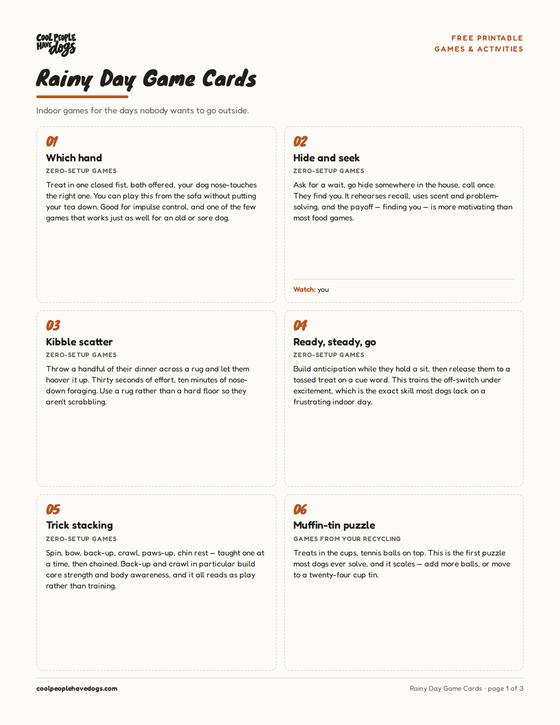
Grab the free rainy day game cards.
All 15 indoor games as printable cards — plus new game guides as they're published.
What indoor game fits your dog on a rainy day?
Five questions for when going out isn't happening. Indoors limits space, not options.
5 questions · no email needed
How big is the space you can actually use?
What does your dog do when they're bored indoors?
What's downstairs like - floors, breakables?
How food-motivated are they?
How long do you need to fill?
Indoor Nosework
A food-motivated dog in a hallway is ideal for scent games, which are the best value indoor activity by a distance - sniffing is genuinely tiring in a way that indoor running isn't, and it needs almost no space. Start with treats scattered in a towel or under cups, then hide them around the room while they wait outside. Twenty minutes of this outperforms a damp walk.
Structured Tug and Toy Swaps
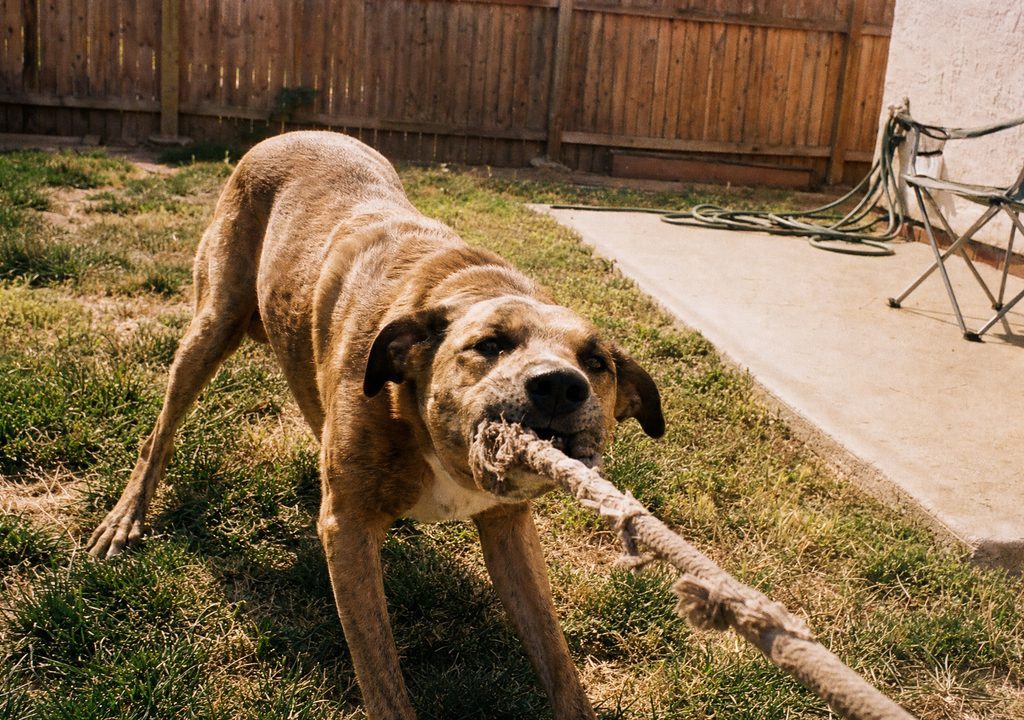
A toy-driven dog with space to move wants a game with a partner in it, which is what tug is. Keep it structured - take on cue, release on cue, restart - and run it in short bursts rather than one long session, with a settle in between. The settle is the part that makes the rest of the afternoon quiet.
Food Puzzles and Long Chews
Hard floors, a dog that chews when bored, and a long stretch to fill: that's a food-puzzle afternoon. A stuffed and frozen toy, a snuffle mat or a lick mat buys real time, works with no space and no skidding, and aims the chewing at something legitimate. Rotate which puzzle appears so it stays interesting.
Short Training Games
A tight space and a dog who paces and stares is the case for ten focused minutes of training rather than any kind of physical game. Teaching something new - a trick, a name for a toy, a chin rest - is cognitively expensive and works in a square metre. Finish before they lose interest; stopping early is what makes them keen next time.