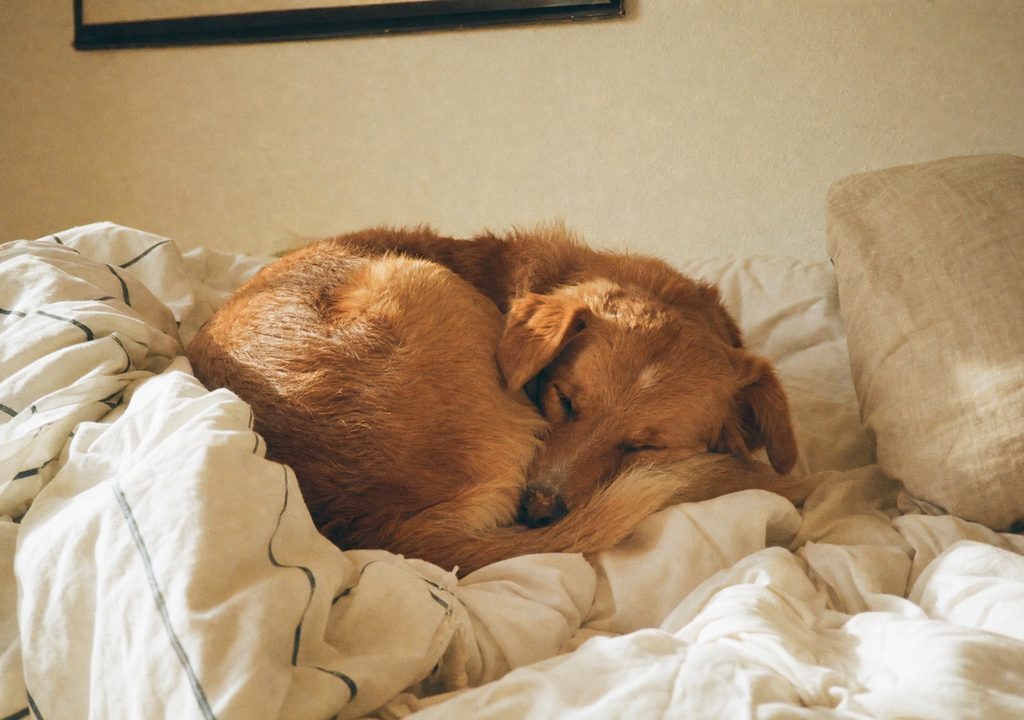
Sleeping position is mostly about temperature and joint comfort. No study has ever tested whether posture reveals a dog's personality or how much they trust you — those readings were invented. The one posture change that genuinely matters is medical: a dog that stops sleeping on its side or back and props itself upright may be in heart failure.
I went looking for the research behind "what your dog's sleeping position means," fully expecting to find a study or two I could cite.
There isn't one. Not a single published study has tested whether a dog's sleeping posture predicts its emotional state, its personality, or its relationship with you. The charts you've seen — donut means anxious, belly-up means total trust — are assertions, repeated until they sounded like facts. Much like the usual explanation for the head tilt, which the research also doesn't support.
So this is the honest version. Which positions are actually common, what genuinely drives them, what the sleep science does know, and the one change in sleeping position that's worth calling your vet about. That last one turns out to be the exact opposite of what the folklore says.
The Positions, Honestly Graded
Two things we do have real numbers for: how often dogs adopt each posture. A survey of 1,042 owners found 84% said their dog stretches out on its side and 64% said their dog curls up. Most dogs do both, depending on the hour and the room temperature.
That alone should make you suspicious of the personality charts. If nearly every dog does nearly every position, the position can't be telling you much about that particular dog.
| Position | What you've been told | What's actually known |
|---|---|---|
| On their side | Deep sleep, feels safe | Genuinely the most common position. The "feels safe" part is inference. |
| Curled in a donut | Anxious, or protecting vital organs | Heat conservation is physically sound but untested in dogs. "Protecting organs" has no basis at all. |
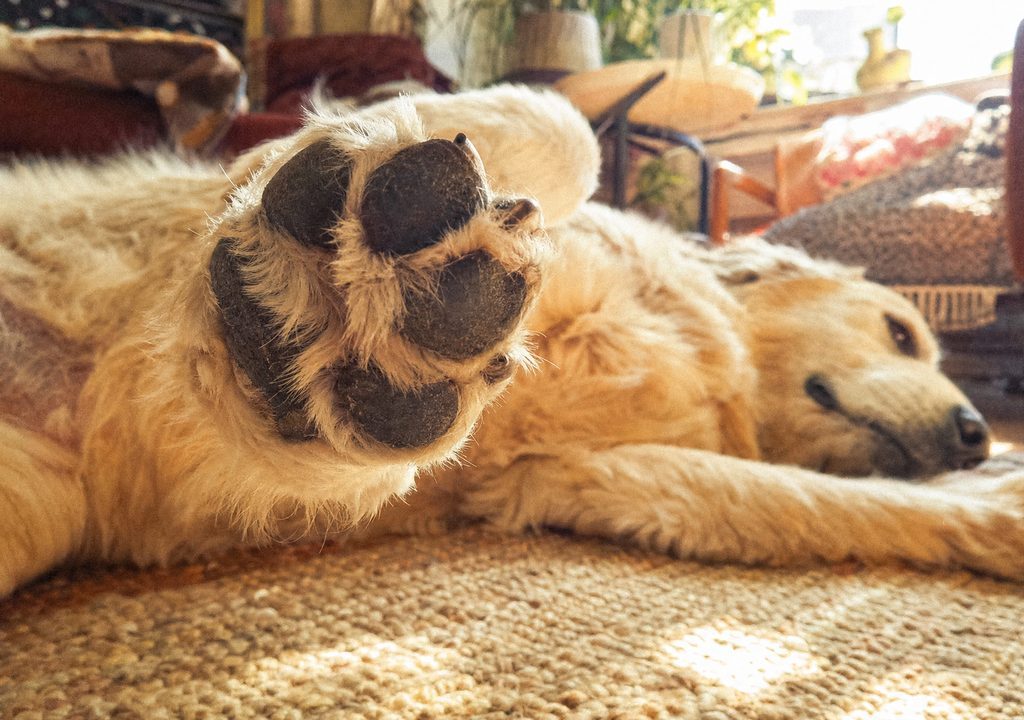
| Belly-up | Ultimate trust in you | Cooling and joint comfort fit better. Older dogs do it less — which the trust theory can't explain. |
| Superman / sploot | Puppy energy, ready to spring | Probably cooling on a hard floor. A new sploot in a senior dog is worth a vet visit. |
| Pressed against you | You're the favourite | Closest to true. Dogs sleep measurably better with their owner nearby — though nobody studied the specific pose. |
| Burrowed under blankets | Ancient denning instinct | No study exists. Warmth and enclosure are the simpler explanation. |
| Sphinx / lion pose | Resting but alert | Invented — and sources contradict each other. One says full of energy, another says can't relax. |
That last row is my favourite illustration of the problem. Two authoritative-sounding sources give opposite readings of the same pose, and neither offers a shred of data.
The proximity finding is the one worth keeping. Dogs recorded with their owner present showed better sleep efficiency and fell asleep faster than with a stranger. It's a small study — nine dogs, and the authors call it preliminary — but it's real measurement rather than vibes, and it's a decent argument for letting your dog sleep in the bedroom.
Why Dogs Curl Up
The heat explanation makes physical sense. Curling reduces the surface area exposed to cold air, and less exposed surface means less heat lost. That's not controversial physics.
What's missing is the dog. Nobody has run the study measuring ambient temperature against sleeping posture in dogs. The hard evidence for huddling-and-warmth comes from rodent work — voles huddling in the cold showed a substantially lower resting metabolic rate — and extrapolating from four voles to one curled labrador is reasoning, not a finding.
"Protecting the vital organs," though, I'd drop entirely. It's not a hypothesis anyone has tested. It's a story that sounds evolutionary enough to pass unchallenged.
Same for belly-up. Exposing a thinly furred belly to the air would help a dog shed heat, which is coherent — and untested. Given dogs cool themselves mainly by panting, with paw pads contributing almost nothing, the belly is at least a plausible radiator.
What We Actually Know About Dog Sleep
Here's the frustrating irony: there's excellent research on canine sleep. It just measures brainwaves rather than body shapes, so it never makes the listicles.
A Budapest team developed a non-invasive way to run sleep EEGs on dogs, and the picture that emerged is genuinely different from ours:
- Sleep comes in bouts, not blocks. One study recorded around 11 separate sleep bouts a night, ranging from 5 to 23. Your dog getting up and resettling repeatedly is normal.
- The cycle is about half as long as yours. Roughly 51 minutes against the human 90.
- Dogs often wake up after REM. Where a human typically drops back into deeper sleep, dogs are more likely to surface. The researchers had to redefine "sleep cycle" to describe dogs at all.
- Total sleep estimates vary a lot by method. Owners of young dogs reported about 11 hours a day; direct observation of lab dogs found around 6 hours overnight. Treat any confident single number with suspicion.
Sleep also responds to what happened that day. After a negative social experience, dogs fell asleep faster and showed proportionally more REM — the opposite direction to humans. Whatever that means, it means sleep is doing something, not just passing time.
The Twitching and Paddling
Everyone says they're chasing rabbits. Maybe. But the better-evidenced explanation is less romantic and more interesting.
Work on sleep twitches found they aren't random spasms. They're structured — paired between limbs, organised within a limb, and growing more complex as an animal matures. The argument is that twitching during active sleep is a form of motor exploration, the nervous system quietly mapping and maintaining the body's wiring. That research is in rodents, and the principle is thought to hold across mammals.
As for dreams, we genuinely don't know. Deirdre Barrett at Harvard reasons that whatever dogs find interesting by day is what you'd expect in their dreams. David Peña-Guzmán cautions against assuming dogs dream the way we do at all — and raises the lovely possibility that a dog's dreams are made of smells.
One popular claim to retire: the story that researchers lesioned dogs' brainstems and watched them act out dreams. Those experiments were done in cats, in the 1970s. The dog version appears to be a transposition that stuck.
Practical upshot: leave a twitching dog alone. They're not distressed, and dogs wake easily after REM on their own.
The One Position Change That Matters
This is the part I'd want every dog owner to know, and it inverts the whole genre.
Tufts' veterinary cardiology service lists sleep changes among the signs of heart disease. A dog developing heart failure may stop sleeping on its side or back and start sleeping propped on its chest, may stop wanting to sleep under the covers, may wake in the night and go to a window for air, and may sleep restlessly because fluid is making breathing harder. Sleep changes in an older dog are worth reading alongside how much they're still moving in the day.
Read that against the folklore. A dog that gives up belly-up sleeping hasn't stopped trusting you. It may be unable to breathe comfortably lying flat.
That's the real signal in sleeping position, and it has nothing to do with personality: what matters is a change from your own dog's normal, not which pose they favour.
The same logic covers joints. Older dogs sleep belly-up less often, which fits comfort rather than character. A senior dog suddenly adopting a new position, or struggling to get up, is worth an arthritis check — and an older dog's whole routine may need adjusting alongside it.
I'll be straight about the strength of the pain evidence, though: when researchers measured nighttime movement in dogs with arthritis using accelerometers, they did not find the restlessness owners reported. Owner-reported sleep improved on pain medication; the movement data didn't confirm it. Pain may degrade sleep quality without showing up as extra movement.
When to Call Your Vet
Same day, or immediately for the first two:
- Won't lie down flat, or props itself upright to sleep when it never used to — a sign of difficulty breathing lying down
- Elbows pointed out, neck stretched forward, continuous panting, exaggerated chest and belly movement, or blue-tinged gums — a respiratory emergency
- Waking at night to seek air at a window or door
- A senior dog taking up a new sleeping position, or struggling to rise
- Loud snoring, gasping, or pauses in breathing in a flat-faced breed, with daytime sleepiness
- Collapsing suddenly into sleep, particularly when excited or eating
- Violent paddling or vocalising you can't rouse them from — distinguishing a parasomnia from a seizure needs a vet, not a video comparison
- Night waking and day-night reversal in an older dog, which can signal canine cognitive dysfunction
On that last one: a study of senior dogs found those with higher dementia scores had measurably less deep sleep and less REM. Disrupted sleep in an old dog is a real clinical sign, not just an inconvenience — and it's treatable often enough to be worth raising.
Frequently Asked Questions
Does my dog's sleeping position mean anything about their personality?
There's no evidence that it does. No published study has tested whether posture predicts a dog's temperament or how much they trust you, and most dogs use most positions depending on the temperature and the hour. The personality charts were invented.
Should I worry if my dog suddenly changes sleep positions?
A change is the one thing genuinely worth noticing. Most often it's a cold room or a new bed. But a dog that stops lying flat and starts sleeping propped upright can be struggling to breathe lying down, which is a reason to call your vet rather than wait.
Why does my dog sleep upside down?
Most likely to cool off - the belly is thinly furred, so exposing it helps shed heat - and because it's comfortable on the joints. The popular "ultimate trust" reading has never been tested, and older dogs do it less, which that theory can't explain.
Do sleep positions change with age?
Yes. Older dogs sleep on their backs less often, which fits stiffening joints better than any change of heart. A senior dog adopting a new position, or struggling to get up, is worth an arthritis check.
Should I wake my dog when they're twitching?
No. Sleep twitches appear to be organised motor activity rather than distress, and dogs wake easily on their own after REM anyway. The exception is violent paddling or vocalising you can't rouse them from - that needs a vet, because a parasomnia and a seizure can look similar.
Article Sources
- Kinsman, R. et al. "Sleep Duration and Behaviours: A Descriptive Analysis of a Cohort of Dogs up to 12 Months of Age." Animals, 2020 — full text.
- Schork, I. G. et al. "The cyclic interaction between daytime behavior and the sleep behavior of laboratory dogs." Scientific Reports, 2022 — full text.
- Kis, A. et al. "The interrelated effect of sleep and learning in dogs." Proceedings of the Royal Society B, 2017 — full text.
- Reicher, V. et al. "Interhemispheric asymmetry during NREM sleep in the dog." Scientific Reports, 2021 — full text.
- Baranyai, C. et al. "The Effect of the Owner's Presence on Dogs' Sleep." Animals, 2025 — full text. Nine dogs; the authors describe it as preliminary.
- Blumberg, M. S. et al. "Spatiotemporal Structure of REM Sleep Twitching Reveals Developmental Origins of Motor Synergies." Current Biology, 2013 — full text.
- Mondino, A. et al. "Sleep and cognition in aging dogs: A polysomnographic study." Frontiers in Veterinary Science, 2023 — full text.
- Tufts Cummings School of Veterinary Medicine, "Difficulty Sleeping or Altered Sleep Patterns".
- Royal Veterinary College, "Respiratory Distress in Cats and Dogs".
- "Initial evaluation of nighttime restlessness in a naturally occurring canine model of osteoarthritis pain." PeerJ, 2015 — full text.
- Dr Deirdre Barrett and Dr David Peña-Guzmán on animal dreaming, Scientific American.
This article is general information, not veterinary advice. Any change in how your dog breathes or settles at night is worth a call, not a search.
So enjoy the donut and the dead bug for what they are — a warm dog finding a comfortable shape. Just keep a rough mental picture of how yours normally sleeps. That picture is the only thing on this page that will ever tell you something urgent.
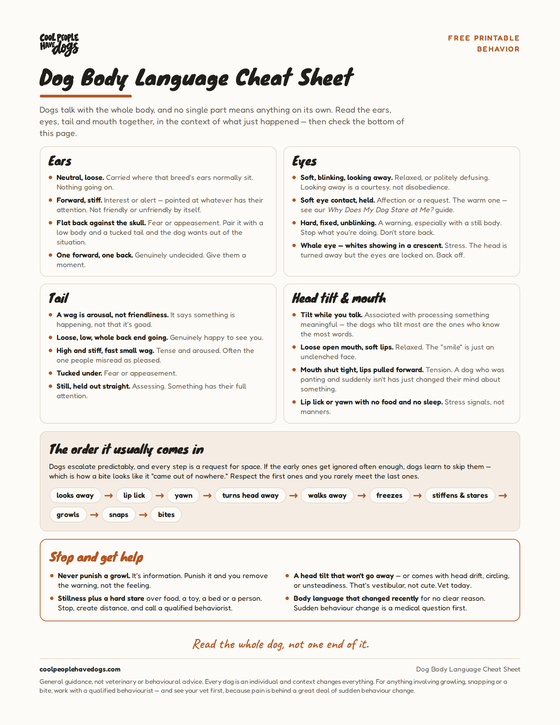
Grab the free Dog Body Language Cheat Sheet.
Sleeping posture is one signal among many. One printable page covering ears, tail, eyes and stance — what your dog is telling you while they're awake, too.
What's your dog's sleep style?
Five questions about how your dog actually sleeps. Positions shift with temperature, age and how safe they feel — so this is a snapshot, not a diagnosis.
5 questions · no email needed
Default position when they're properly out?
Where do they choose to sleep?
How easily do they wake up?
Does the position change through the night?
Do they sleep touching you or another pet?
The Belly-Up Believer
Sleeping upside down with the belly exposed is about as vulnerable as a dog gets, and they only do it where they feel genuinely safe. It's also an efficient way to dump heat, so it shows up more in summer. If your dog sleeps like this near you, take the compliment.
The Classic Curl
The oldest position in the book — conserves heat, protects the vital organs, and lets them get up fast. It doesn't mean they're anxious. It often just means they're cold, or that curling is simply what feels normal to them. Worth noting if a previously sprawling dog starts curling tightly and stays that way.
The Side-Lying Sprawler
Legs out, fully committed, deep sleep. This is the position where most dream twitching happens, because it's the one they reach REM in. Common in dogs who are comfortable in their space and not expecting to be disturbed.
The Light Sleeper on Duty
Chin on paws, facing the room, up at the smallest sound. Some of this is breed wiring and some is habit, and neither is a problem on its own. But if it's new, or paired with restlessness and trouble settling, that's the version worth mentioning to your vet.