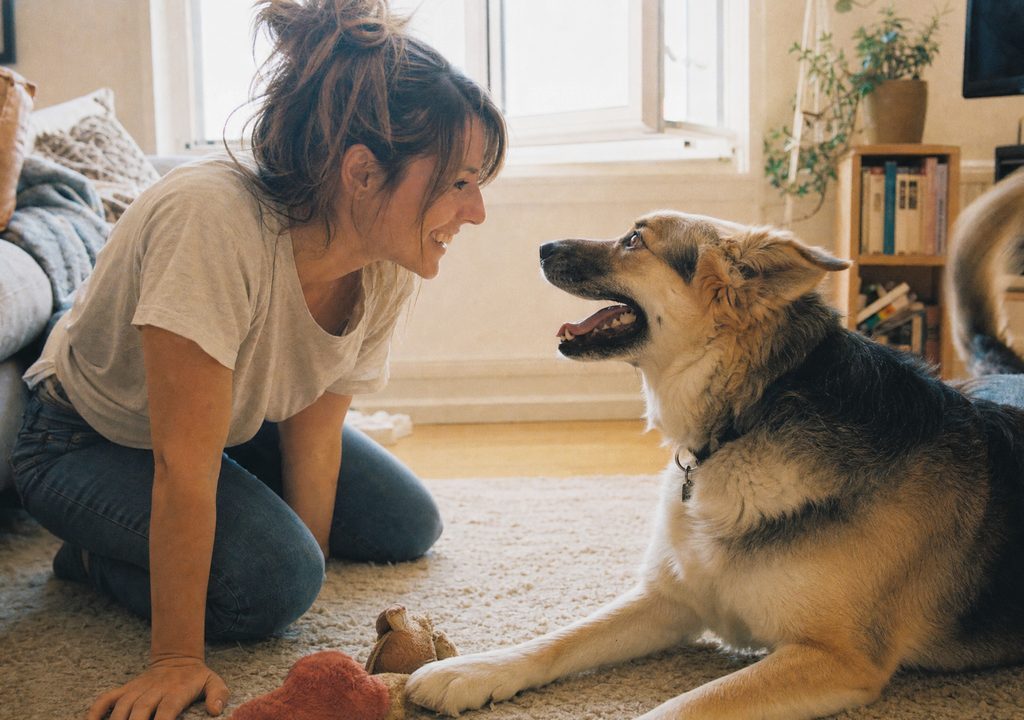
Dogs stare at you because they're bonded to you, because they want something, or because they're waiting for a cue. Soft eyes and a loose body mean affection. A stiff, unblinking stare with a frozen body is the one version worth taking seriously.
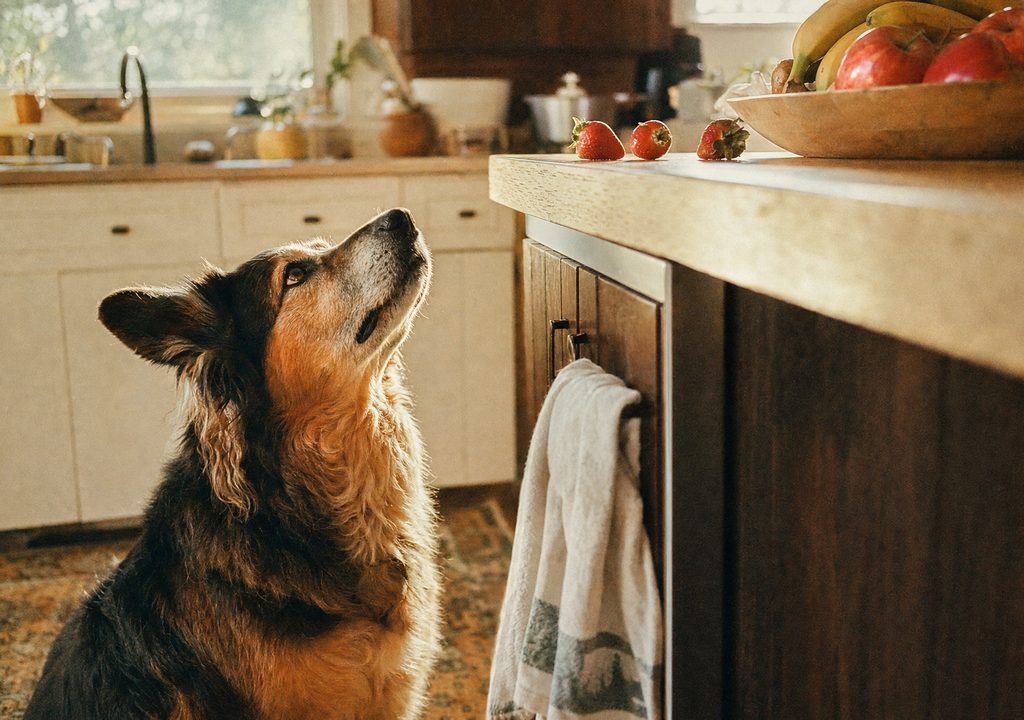
I'll be mid-sandwich, minding my own business, and look over to find my dog just... staring. Not blinking. Not moving. Fully locked on, like I'm the most interesting thing that has ever happened in this kitchen.
It used to unsettle me a bit. Then I started paying attention to which stare I was getting, and the whole thing made sense. Most staring isn't creepy at all — it's one of the most "this dog is attached to you" things a dog can do. A small slice of it is a request. And a much smaller slice is your dog telling you something you should actually listen to.
Here's how to tell them apart.
It's Probably Love (Really)
Start with the genuinely sweet explanation, because statistically it's the right one.
In 2015, a team led by Takefumi Nagasawa at Azabu University published a study in Science that got a lot of attention, and deserved it. They measured oxytocin — the hormone associated with bonding, the one that spikes between parents and infants — in both dogs and their owners during ordinary interaction. The dogs that gazed at their owners longest produced the biggest oxytocin bump in those owners. The owners then gave more affection back. And that affection raised oxytocin in the dogs.
It's a loop. Your dog looks at you, you feel warm about it, you respond, your dog feels warm about it, your dog looks at you more.
The detail that gets me is the control group. The researchers ran the same test with hand-raised wolves, which are about as close to a dog as you can get genetically. The wolves barely held eye contact at all. In wolf social language, a direct stare is a challenge — something you do before a fight, not during a cuddle.
Somewhere across thousands of years of domestication, dogs did something no other animal did with us: they took a signal that meant threat and turned it into a signal that means connection. Your dog staring at you from the rug is the end product of that.
What the affectionate stare actually looks like
- Soft eyes. Blinking normally. You can often see a sliver of the lower lid relax.
- Loose body. Lying down, leaning, flopped, maybe a slow tail sweep.
- It survives you looking back. You make eye contact, they hold it and go softer rather than tensing.
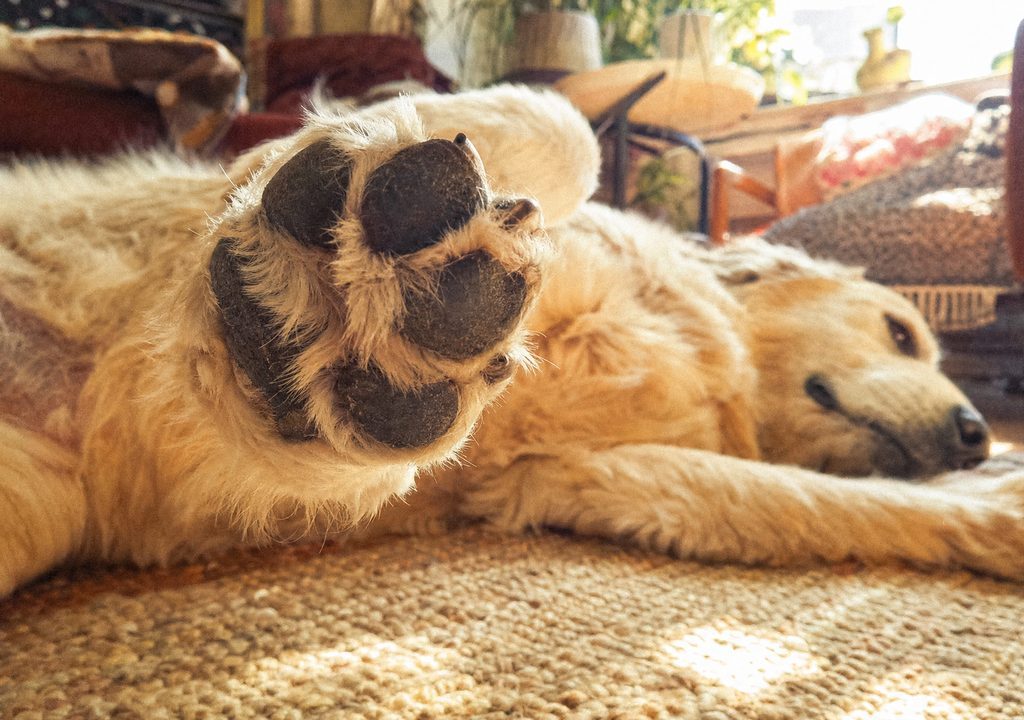
- It fades into sleep. The most common ending to a loving stare is a dog falling asleep mid-stare, which is the whole thing in miniature.
If you want to lean into it, hold the eye contact for a few seconds and say something quietly. You're not imagining the response. That's the loop doing its thing.
Or They Want Something (Also Very Common)
Let's be honest, though. Not every stare is a Hallmark moment.
A large share of dog staring is simply direct communication. I would like that thing you're eating. I would like to go outside. I would like you to stop looking at the laptop. Dogs can't tap you on the shoulder, so they use the one tool that reliably works: they look at you until something happens.
And here's the part worth sitting with — you taught them this. Not deliberately, but thoroughly. The first time your dog stared at you while you ate and you gave them a crust, you ran a training session. Staring produced food. Dogs are very good at noticing which behaviours pay out.
This is why the request stare is so common around:
- Food. Your plate, the treat cupboard, the exact drawer the good stuff lives in.
- Doors. Especially if they've learned you don't always notice the subtler ask.
- Transitions. You standing up, picking up keys, closing a laptop.
- Specific times of day. Dogs keep better time than we do.
You can usually spot a request stare by what the rest of the dog is doing. The eyes flick — to you, to the thing, back to you. That glance is the giveaway. A loving stare rests on you; a request stare keeps checking the target.
What to do about it
If it's occasional, nothing. It's charming and it's communication.
If it's tipped into pestering at every meal, the fix isn't to stamp out staring — it's to make staring stop paying. Give them something better to do during your dinner: a chew, a stuffed toy, a mat they get rewarded for settling on. Trying to train away a behaviour that has worked hundreds of times is much harder than giving it a replacement.
One thing I'd avoid: feeding from the table sometimes. Intermittent payouts are the most durable kind of reinforcement there is. It's the same reason slot machines work.
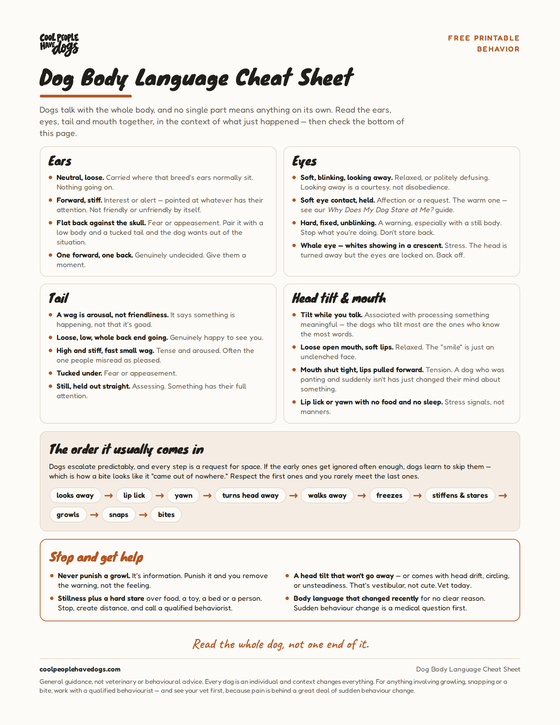
Grab the free Dog Body Language Cheat Sheet.
The stare is one signal out of many. One printable page covering eyes, ears, tail and stance — so you can read the whole dog, not just the gaze.
Waiting for a Cue
There's a third stare that isn't about affection or wanting — it's about work.
Dogs read us constantly. They track where we're looking, which direction we point, how our body turns. For a dog bred to take direction at a distance — collies, shepherds, most of the herding and gundog groups — watching a human's face is basically the job description.
If your dog is staring at you with ears forward, body ready rather than relaxed, and a general air of "say the word," that's not a request. That's a dog on standby. You'll see it most:
- During training, between reps
- At the door before a walk, once the lead is already on
- On a walk when they've stopped and want to know which way
- Any time you've picked up a toy and haven't thrown it yet
This is the stare that's easiest to under-serve. A dog who spends a lot of the day on standby is a dog whose brain isn't being used, and it tends to show up elsewhere — pacing, pestering, finding its own entertainment. If that sounds like your evenings, the fix is usually mental work rather than more walking. Five minutes of nosework tires a dog like twenty minutes of fetch.
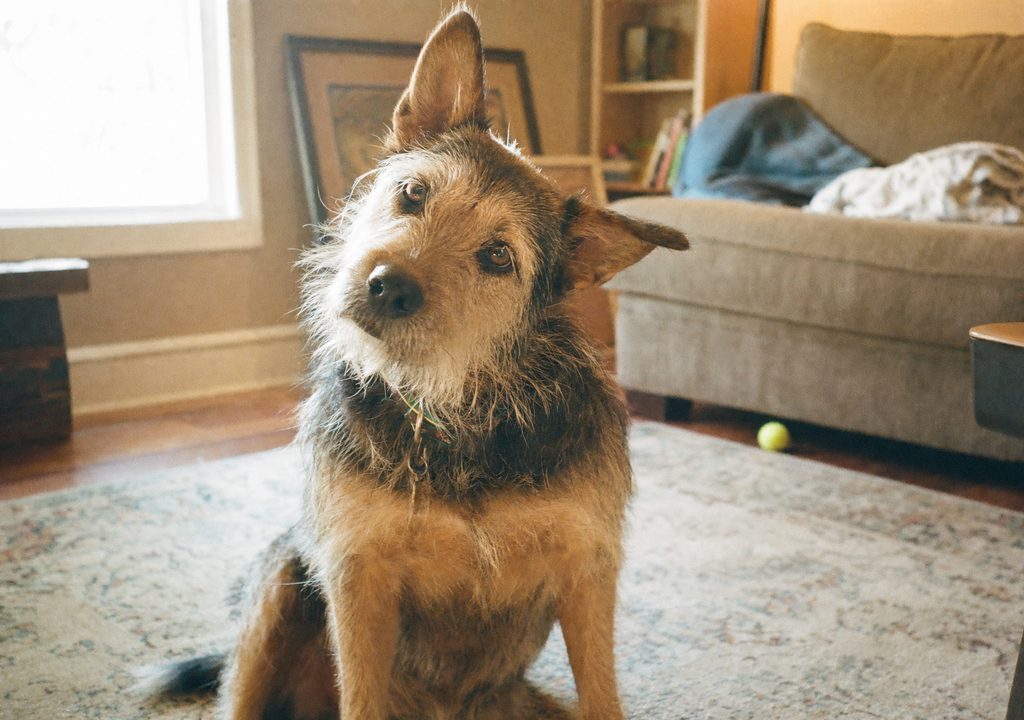
It's the same attentiveness behind the head tilt when you talk to them — your dog working to extract meaning from a face that doesn't quite work the way a dog's does.
When Staring Is a Warning
Now the version that matters.
A hard stare is a real signal, and it looks different from everything above. The giveaway is stillness. An affectionate dog is loose. A requesting dog is fidgety. A dog giving a hard stare has gone quiet in its body.
Look for:
- A frozen body. Movement stops. This is the single most reliable sign.
- Unblinking eyes, often with the whites showing at the corners.
- A closed, tight mouth. Panting stops abruptly.
- Weight shifted forward, or a lowered head over whatever they're guarding.
- Context. Nearly always a resource: food, a bone, a toy, a bed, sometimes a person.
The American Kennel Club's guidance on resource guarding describes this freeze-and-stare as an early link in a chain that runs from stiffening to a lip curl to a growl to a snap. The important thing about that chain is that the stare is the polite end of it. Your dog is telling you it's uncomfortable while it still has options.
What to do in the moment
Don't stare back, don't lean over the dog, and don't reach in to take the thing. All three escalate. Stop moving, turn your body slightly side-on, and give them space. Trade rather than confiscate — a better item tossed a few feet away gets you the first one without a confrontation.
And never punish a growl. A dog that learns growling gets it in trouble doesn't stop feeling guardy; it just skips the warning next time. The growl is the smoke alarm, not the fire.
When to get professional help
Talk to a vet or a qualified behaviourist if any of this applies:
- The hard stare happens more than occasionally, or over more things than it used to
- There are children in the house
- It's escalated past the stare — growling, snapping, lunging
- It's new behaviour in a dog who never did it before, which can have a medical cause; pain changes temperament
Start with the vet, not a trainer, if it appeared suddenly. A dog guarding a bed because its hips hurt needs treatment, not training. If you've recently brought a dog home, some wariness is normal and usually settles — our guide to a newly adopted rescue's first weeks covers what that curve typically looks like.
The Senior Dog Exception
One more worth knowing about, because it gets mistaken for the others.
If an older dog starts staring at walls, into corners, or at nothing in particular — rather than at you — that's a different behaviour. In senior dogs it's one of the signs associated with canine cognitive dysfunction, the rough equivalent of dementia. Often it comes with other changes: pacing at night, getting stuck behind furniture, seeming lost in familiar rooms, or a shifted sleep schedule.
It can also have other medical causes entirely, including vision changes and some kinds of seizure activity. Either way it's a vet conversation rather than something to interpret at home. There's more that can be done about it than most owners realise, and earlier is better.
Separately: a senior dog staring at you more than they used to is often just a dog whose hearing or sight is fading, leaning harder on the sense that still works. That one's worth a bit of extra patience — and possibly a look at how their daily routine is holding up.
How to Read Your Dog's Stare
Everything above, in one place. In practice you'll diagnose this from the body, not the eyes.
| The stare | What the body's doing | What it means | What to do |
|---|---|---|---|
| Soft gaze | Loose, lying down, normal blinking | Affection and bonding | Hold it. Enjoy it. |
| The request | Eyes flicking between you and a target | They want a specific thing | Answer it, or redirect it |
| On standby | Ears forward, ready, poised | Waiting for a cue | Give them a job |
| Hard stare | Frozen, unblinking, tight mouth | Discomfort, often guarding | Back off, don't punish, get help |
| Into space | Aimed at a wall, not at you | Possible medical cause | Vet, especially in a senior |
If you're not sure which one you're looking at, the shortcut is this: a dog that's frozen is telling you something; a dog that's loose is just being a dog. You'll also get good at this faster than you expect — the same way you learn to read what your dog's sleeping position says about them without thinking about it.
Frequently Asked Questions
Is it bad to stare back at my dog?
No — mutual, relaxed eye contact is part of what builds the bond in the first place. It's prolonged, hard staring from a stranger (or into an anxious dog's face) that can come across as a challenge.
Why does my dog stare at me while I eat?
Almost always a want, not a warning — your dog has learned that staring sometimes gets results.
Why does my dog stare at the wall or into space?
That's a different behavior worth a separate conversation, especially if it's frequent or paired with other odd signs — not the same as staring directly at you.
Should I train my dog to stop staring at me?
Usually not necessary. If it's food-related and becoming a nuisance, redirecting with a command or a puzzle toy works better than trying to eliminate the behavior entirely.
Do puppies stare the same way adult dogs do?
The bonding behavior develops early, but puppies stare more out of general curiosity and learning — they're still figuring out what gets a reaction from you.
Article Sources
- Nagasawa, M. et al. "Oxytocin-gaze positive loop and the coevolution of human-dog bonds." Science, 2015 — summarised in National Geographic and TIME.
- American Kennel Club, "Resource Guarding: Why Does My Dog Guard Objects?"
- Victoria Stilwell Positively, "Resource Guarding"
This article is general information, not veterinary advice. Anything sudden, escalating, or out of character is worth a conversation with your own vet, who can actually examine your dog.
Next time your dog locks on from across the room, check the body before you check the eyes. Loose means you're being loved at. Frozen means you're being told something. You'll start seeing the difference everywhere.
What's your dog's stare actually saying?
Five quick questions about when and how your dog locks eyes with you. No right answers — just a read on what's probably going on behind them.
5 questions · no email needed
When does the staring usually start?
What's the rest of their body doing?
What happens if you look back at them?
How long does it go on?
What ends it?
The Love-Struck Gazer
This is the good one. Soft, sustained eye contact with relaxed body language is the oxytocin loop the research keeps pointing at — the same feedback cycle that runs between parents and infants. They're not asking for anything. They're just glad you're there, and holding the look is how they say it.
The Hungry Opportunist
Your dog has run the numbers and concluded that staring at you is the single highest-yield activity available. It works, which is why it continues. Harmless — but if it's tipping into pestering at every meal, redirecting to a puzzle toy beats trying to train the stare away.
The Anxious Check-In
This stare is information-gathering. They're reading you to figure out what happens next, which is common in rescues and dogs still learning a household's rhythm. Predictable routines do more for this than reassurance in the moment does. Worth watching if it comes with pacing or panting.
Bored and Scheming
This is a request, not a feeling. They have energy, you have hands, and staring is the most direct lever they've got. The fix isn't subtle — more physical and mental work earlier in the day, before the staring starts.