A small yard is a poor running track and an excellent search area. Stop trying to get distance out of it and start hiding things in it — a scattered meal in long grass or a grid of baited plant pots turns twenty square metres into fifteen minutes of work.
Small yards get written off, usually by people who are thinking about them as somewhere to throw a ball.
Your dog doesn't need distance. They need something to solve, something to find and something to chase that doesn't require a run-up. All three fit in a courtyard. Here are fourteen games built around what a small space is actually good for.
Turn the Yard Into a Search Area
This is the whole trick. A nose doesn't care about square footage.
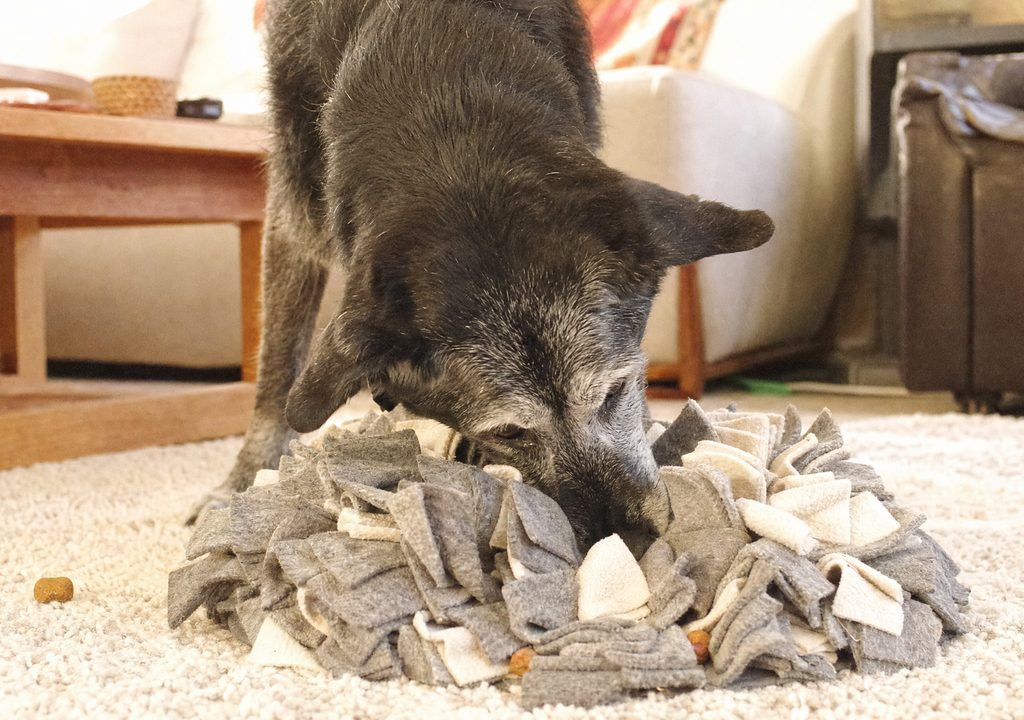
1. Lawn scatter hunt. Toss a handful of kibble into longer grass and walk away. The cheapest, most repeatable enrichment there is, and it converts a meal into fifteen minutes of nose-down foraging. If your grass is short, scatter into a pile of fallen leaves instead.
2. Scent pot grid. Six to ten upturned plant pots or boxes in a loose grid, one or two baited. Your dog works the grid to find them. Difficulty scales beautifully: move the pots between rounds, or bait them and wait five minutes before releasing your dog so the scent has time to settle.
3. Perimeter scent trail. Drag a scented sock around the fence line in a spiral, finishing at a hidden reward in the middle. You get thirty metres of tracking out of a garden you could cross in four steps.
4. Find the person. Hide behind the shed, the bins, a bush, the car. Release your dog to find you. Social, scent-based and genuinely engaging even in a tiny space — and it quietly builds recall.
5. Log and brush foraging pile. A heap of safe logs, branches and leaves with food hidden through it. This adds vertical and textural complexity to a flat yard, which is the thing small gardens most lack. Avoid treated timber and anything toxic — yew and oleander in particular.
Chase Games With No Run-Up
6. Flirt pole, short-arc version. Tight figure-of-eight sweeps close to your own feet rather than long arcs. You get the full chase-and-catch sequence inside a three-metre circle. Because the turns are tighter, keep sessions to sixty or ninety seconds with real breaks, and keep the lure on the ground — never overhead.
7. Treibball. Teaching your dog to nose-push a large exercise ball toward a goal. One of very few genuinely tiring games that needs no run-up at all, and it's as much training as exercise. Herding breeds take to it immediately.
8. Diagonal restrained recalls. Use the longest line the yard allows, corner to corner. One person holds, the other calls. Makes real speed out of a small footprint — just make sure there's braking room and they aren't sprinting at a fence.
9. Jolly ball soccer. An oversized ball with a handle that your dog can bat, chase and carry without you throwing anything. Self-play, no skill required, and no throw rate for you to keep up with.
Things Worth Building Once
10. Dig pit. A child's paddling pool or a defined corner filled with sand, with toys buried in it. Digging is strongly self-reinforcing and burns real energy. In a small yard this is the difference between a channelled instinct and a cratered lawn — give them somewhere it's allowed and most dogs stop digging elsewhere.
11. Hanging bottle spinner. A plastic bottle on a rod or rope strung between two posts, holes drilled in it, kibble inside. They spin it to release food. Twenty minutes to build, then it works without you. Remove the cap and the ring, and replace the bottle once it's chewed through.
12. Low cavaletti loop. Four to six broom handles laid flat or on very low blocks, spaced to your dog's stride, walked as a circuit. This is a genuine physiotherapy exercise — deliberate, low-impact work on limb placement and core strength. Keep the poles at or below wrist height and walk them, don't trot or jump.
Water and Hot Weather
13. Paddling pool bobbing. A few inches of water, floating toys and treats to retrieve by mouth. Cooling, low-impact, novel, and it takes up almost no room.
14. Frozen food block. Kibble, a little broth and a couple of toys frozen in an ice-cream tub, turned out onto the grass. Long-duration licking and working at it. Perfect for a hot afternoon, and it's the one game on this list that happens entirely without you.
If you use a sprinkler for chase games, watch for dogs who can't disengage — a few become genuinely fixated on water jets — and don't let them drink much pressurised spray.
What Small Yards Are Actually Bad At
Two honest limitations, because pretending otherwise doesn't help anyone.
Sustained running. You can't manufacture that in a small space, and repeated tight turns at speed are worse for joints than straight-line sprinting. If you have a high-drive dog, the yard supplements their exercise; it doesn't replace off-property time — and what that time should actually look like is its own list. The one bright spot: a 2025 study of around 28,500 dogs found a mean of roughly 51 active minutes a day, with an enormous range between individuals — so the bar may be lower than you think, and it's your dog's bar, not a breed chart's.
Fence running. Small yards with a visible street or a neighbouring dog can create a daily patrolling habit that winds a dog up rather than settling them. If your dog does laps of the fence line barking, that's not exercise — screen the fence, or move the games to the opposite end.
What small yards are genuinely good at is nose work, and that's not a consolation prize. Two weeks of nosework training has been shown to measurably shift dogs toward optimism on a judgement-bias test. Just don't expect it to calm them in the moment — when researchers measured it, heart rate was actually highest during a scent search.
Frequently Asked Questions
Is a small yard enough exercise for a dog?
It supplements their exercise rather than replacing off-property time, especially for a high-drive dog. But small spaces are genuinely good for scent work and problem-solving, which tire many dogs more effectively than running does.
How do I stop my dog digging up the lawn?
Give them somewhere digging is allowed. A sandbox or child's paddling pool filled with sand, with toys buried in it, redirects the instinct rather than fighting it - and most dogs stop digging elsewhere once they have their own spot.
My dog runs the fence line barking. Is that exercise?
No, and it's usually making things worse. Fence patrolling in a small yard becomes a daily habit that winds a dog up rather than settling them. Screening the fence or moving your games to the far end helps more than tiring them out will.
What's the cheapest thing I can do today?
Scatter a handful of their dinner into longer grass. It costs nothing, takes four seconds, and turns a meal into fifteen minutes of foraging.
Are tight turns bad for my dog's joints?
Repeated high-speed turning is harder on joints than straight-line running, which is why small-yard games are better built around searching than sprinting. If you do chase games in a tight space, keep sessions short with real breaks.
Article Sources
- O'Rourke, A. et al. "Estimated activity levels in dogs at population scale." Frontiers in Veterinary Science, 2025 — full text.
- Duranton, C. & Horowitz, A. "Let me sniff! Nosework induces positive judgment bias in pet dogs." Applied Animal Behaviour Science, 2019 — summary.
- Fountain, J. et al. "Heart rate variability and behaviour in dogs during and after scent work." Applied Animal Behaviour Science, 2026 — record.
- Mille, M. A., McClement, J. & Lauer, S. "Physiotherapeutic Strategies and Their Current Evidence for Canine Osteoarthritis." Veterinary Sciences, 2022 — full text.
- Anderson, K. L. et al. "Risk Factors for Canine Osteoarthritis and Its Predisposing Arthropathies: A Systematic Review." Frontiers in Veterinary Science, 2020 — full text.
This article is general information, not veterinary advice.
Start with the scatter hunt tonight — it costs you one handful of dinner and about four seconds. Most people are surprised how long a small dog can work a small lawn.
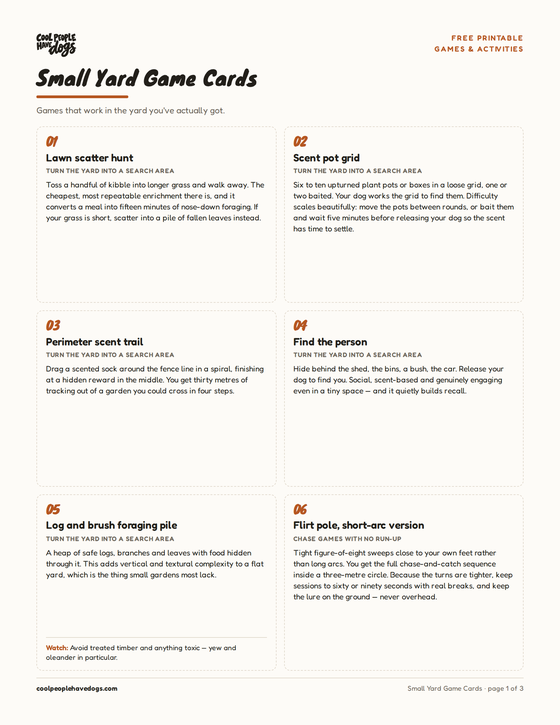
Grab the free small yard game cards.
14 games built for tight spaces — plus new game guides as they're published.
What game works in your small yard?
Five questions about your space and your dog. A small yard rules out distance, and almost nothing else.
5 questions · no email needed
How small are we talking?
What's the ground like?
What does your dog do out there now?
How do the neighbours factor in?
What are you trying to achieve?
Scatter Feeding
A few strides of patchy grass, close neighbours, a dog who sniffs the perimeter and comes back in - scatter feeding fits all of it. Throw a handful of kibble into the grass and let them hunt it out. It's silent, needs no space, and sniffing lowers arousal rather than raising it, which makes it the right thing immediately before you want them to settle indoors.
Flirt Pole
Room for a short sprint, good grip, and a dog waiting for you to start something: a flirt pole is the highest-intensity-per-square-metre game there is. You stand still and the dog does the work, which is exactly what you want in a small space. Build in frequent stops with a sit or a down - the pauses are what turn it into impulse training rather than just winding them up.
Tug on Hard Standing
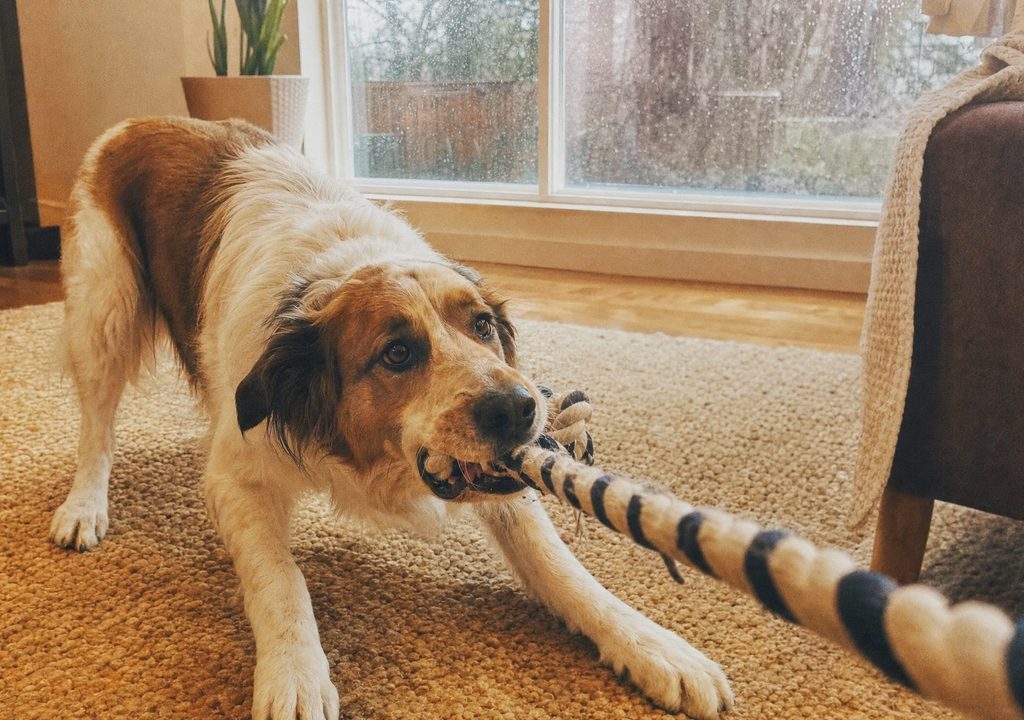
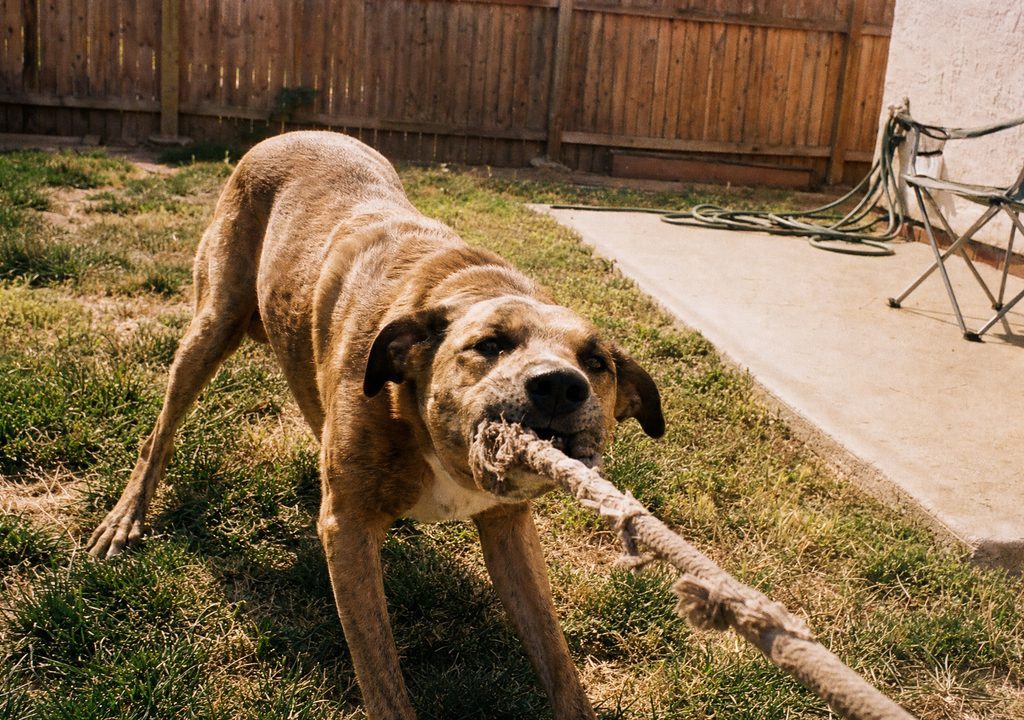
Concrete, a narrow strip, and a dog who brings you a toy unprompted - tug is the game that doesn't care about either constraint, since nobody needs to run. Structure it with a take cue and a release cue, and keep sessions to a few minutes. On hard ground, keep it low and horizontal rather than letting them leap and twist for it.
Fix the Fence First
Patrolling and barking at the fence isn't a game problem, it's a rehearsed habit, and every repetition makes it stickier. Block the sightline where you can, stop unsupervised yard time while it's at its worst, and give the yard a different meaning - go out together, do something brief and structured, come back in. The games only work once the patrolling stops being the default.