
Yes. Blueberries aren't toxic to dogs, they're genuinely low in calories, and most dogs love them. What they won't do is any of the health things the internet promises — the canine studies came back largely empty. Keep portions small, and know that the real danger isn't the berry, it's the blueberry muffin.
Blueberries are one of the few human foods where the answer is a clean yes. No toxin, no hidden catch, no "but only the flesh, never the pit."
What surprised me was the gap between what gets claimed and what's been measured. Researchers have actually fed blueberries to dogs and taken blood samples. The results are considerably more boring than the marketing — and knowing that changes how you should think about them.
So here's the honest picture: how many your dog can have, what the berries genuinely do and don't do, and the two genuinely dangerous things sitting next to them.
Yes — and What's Actually in One
Blueberries don't appear on the ASPCA's list of plants toxic to dogs. Tufts' veterinary nutrition service lists them among acceptable fruit treats, and PetMD's guidance, reviewed by a board-certified vet, is that most dogs can safely eat them plain and in moderation.
The best real-world evidence isn't an article at all — it's a 2025 feeding trial. Researchers fed twelve beagles whole blueberries at 3% of their diet for four weeks, twice over a year. No adverse effects. The dogs also strongly preferred the blueberry diet to the control, which will surprise nobody who has tried to eat blueberries near a dog.
Here's what's in 100 grams of raw blueberries, per USDA FoodData Central:
| Per 100 g | Amount |
|---|---|
| Calories | 57 kcal |
| Sugar | 9.96 g |
| Fibre | 2.4 g |
| Vitamin C | 9.7 mg |
| Vitamin K | 19.3 µg |
| Manganese | 0.34 mg |
The number that matters for treats: one blueberry is roughly 0.8 calories. That's the genuine selling point. A single standard dog biscuit can run 20 to 40 calories; you could hand over a dozen berries for less.
How Many Your Dog Can Have
The rule every veterinary body repeats: treats should be under 10% of daily calories. That's WSAVA's wording, echoed independently by UC Davis's nutrition service and by VCA. The other 90% comes from complete, balanced food, because treats aren't nutritionally balanced.
Using WSAVA's own calorie formula, here's what 10% works out to:
| Dog weight | Daily calories | 10% treat budget | A sensible daily serving |
|---|---|---|---|
| 10 lb | 295–404 | 30–40 kcal | 1–2 berries |
| 30 lb | 673–921 | 67–92 kcal | 3–5 berries |
| 50 lb | 987–1351 | 99–135 kcal | 5–6 berries |
| 70 lb | 1271–1739 | 127–174 kcal | 6–10 berries |
Notice the gap between columns three and four. The 10% budget for a 70lb dog is around 170 calories — over 200 blueberries. That's a mathematical ceiling, not a recommendation. Two hundred berries would deliver an enormous fibre load, and the budget is shared with every other treat your dog gets that day. The last column is what vets actually suggest, and it's what I'd go with.
Treat the calorie figures as approximate. Tufts' veterinary nutritionist describes the formula as giving a ballpark, and WSAVA says the same — real dogs vary with age, activity and metabolism.
Serving them: wash first, serve plain, no stems, nothing added. Fresh and frozen are both fine — frozen makes a decent hot-weather treat. For toy breeds, puppies and dogs who inhale food without chewing, halving or mashing costs nothing. Introduce a few at a time and watch the first time, as with any new food. If you want something more interesting, they work mashed into food or frozen into a simple frozen treat.
What Blueberries Won't Do
This is the section that separates this article from most of them, and I'd rather tell you now than have you spend money on it.
Blueberries are sold to dog owners as a functional food — antioxidants, brain health, cancer prevention, joint support. When researchers actually tested those claims in dogs, here's what happened:
- Exercise recovery: no effect. Alaskan huskies fed blueberries for two months showed no reduction in exercise-related muscle damage. The 2025 beagle study found blueberries changed none of the exercise-induced oxidative markers either. Two studies, same answer.
- Brain ageing: the headline study didn't use blueberries. The famous research showing an antioxidant diet preserved learning in aged beagles used tomatoes, carrots, citrus pulp, spinach, vitamin E, vitamin C and carnitine. No blueberries. The one canine cognition trial that did involve blueberry extract missed its primary endpoint.
- Cancer: no canine evidence at all. The claim travels by way of "linked to fighting cancer in humans," which is not the same sentence.
- Urinary health: borrowed from cranberries, and even cranberry doesn't hold up — a trial in 94 dogs was stopped early when the extract showed no effect on bacteriuria.
- Blueberries in kibble: essentially decorative. Researchers analysed 40 commercial dog and cat foods advertising blueberries and found polyphenol levels minimal to nonexistent, concluding the berries don't meaningfully contribute antioxidants.
There's a dose problem underneath all of this. A blueberry contains roughly 2 to 3 mg of anthocyanins. The five berries a vet would suggest for a 30lb dog deliver maybe 10 to 15 mg — against a concentrated extract in the cognition trial that still didn't hit its mark.
One more red flag worth carrying with you: if an article quotes an "ORAC score," be sceptical. The USDA withdrew its ORAC database in 2012, saying the values had no relevance to the effects of specific compounds and were routinely misused in marketing.
None of which makes blueberries a bad treat. It makes them a treat — low-calorie, well-liked, with real vitamin C and fibre. Just not medicine.
The Risks Worth Knowing
Stomach upset is the realistic one. Too many at once means too much fibre, which means diarrhoea. No source gives a precise threshold, and I'm not going to invent one. Useful detail most articles skip: dark purple or near-black stool after a blueberry session is normal. Stool that's black, tarry and sticky is a different thing and warrants a vet.
Choking gets listed everywhere, though I couldn't find a single documented case of a dog choking on a blueberry. Treat it as a sensible size-and-shape precaution for toy breeds, puppies and gulpers rather than a real hazard. The vet sources openly disagree here — the AKC says they're small enough not to need cutting, PetMD says cut or mash for small dogs. It's a judgement call, and halving costs you nothing.
Diabetic dogs need care but not prohibition. A berry has about 0.15g of sugar. Current veterinary diabetes guidance doesn't ban fruit; it asks that treat calories be counted and that feeding be consistent. Clear it with your vet, and skip dried blueberries, where the sugar is concentrated.
Frozen blueberries and broken teeth: no evidence. You'll see this warning repeated. Neither Cornell's dental guidance nor the veterinary dental literature mentions frozen fruit, and every vet article on blueberries recommends frozen ones without caution. The useful general principle is the thumbnail test — if you can't dent a chew with your fingernail, it's hard enough to crack a tooth. A frozen blueberry fails that test comfortably. Just don't serve them frozen into one solid clump.
Why the Muffin Is the Dangerous Part
If you take one thing from this page, take this. The berry is safe. The baked goods built around it can kill a dog.
Xylitol. The FDA lists muffins, cakes and pies — particularly from in-store bakeries — among products that may contain it. In dogs, xylitol triggers a rapid insulin release and a dangerous drop in blood sugar, often within 10 to 60 minutes. Other serious effects can take 12 to 24 hours to appear, which is why monitoring matters even if your dog seems fine. Signs are vomiting, then weakness, staggering, collapse and seizures. It also appears on labels as "birch sugar." If your dog eats something containing it, go to a vet immediately — don't wait for symptoms.
Raisins pretending to be blueberries. A real risk with bakery muffins. Grapes and raisins cause kidney failure in dogs, with tartaric acid the suspected culprit. Merck's guidance is stark: more than one grape or raisin per 10lb of body weight may be enough to threaten the kidneys. Prognosis is guarded to poor once kidney failure sets in. If you're not certain what's in a muffin, assume the worst.
Also skip canned blueberries, pie filling, anything in syrup, and most blueberry-flavoured yogurts — those can contain xylitol too. Plain, unsweetened, xylitol-free is the only yogurt worth offering.
Berries That Look Like Blueberries and Aren't
This is the part almost nobody covers, and it's the one most likely to matter if your dog forages in the yard or on walks. Several common plants produce dark blue-black berries, and some are genuinely dangerous.
| Plant | Where you'll meet it | What it does |
|---|---|---|
| Pokeweed | Yards and fencerows across the US | Drooling, vomiting, diarrhoea, tremors, collapse. Severe cases need hospitalising. |
| Elderberry | Hedgerows, wild margins | Cyanogenic. The most severe on this list — treat as an emergency. |
| Nightshades | Gardens, waste ground, climbing fences | Drooling, severe GI upset, weakness, dilated pupils, slowed heart rate. |
| Privet | One of the most common hedges there is | Vomiting, diarrhoea, rapid heart rate, weakness, incoordination. |
| Lantana | A popular ornamental | Toxic berry clusters, dark blue-black when ripe. |
| Choke cherry | Wild edges and hedgerows | On the ASPCA's toxic-to-dogs list; cyanogenic family. |
If your dog eats a berry you can't identify: photograph the plant, take a cutting with you, and call your vet or Pet Poison Helpline on (888) 426-4435. Don't try to make your dog vomit unless a professional tells you to — that can make things worse.
The practical version is simpler. Blueberries grow on cultivated bushes with a crown at the base of each berry. Anything your dog finds growing wild is worth a second look before you shrug it off.
Frequently Asked Questions
How many blueberries can my dog have a day?
Roughly 1-2 for a 10lb dog, 3-5 for a 30lb dog, 5-6 at 50lb and 6-10 at 70lb. The 10% treat rule technically allows far more, but that ceiling is shared with every other treat and a hundred berries would wreck your dog's stomach.
Are blueberries actually good for dogs, or just not bad?
Mostly the second. They're genuinely low-calorie and contain real vitamin C, vitamin K and fibre. But canine studies on antioxidant benefits came back largely null, and the famous brain-ageing study people cite used a diet containing no blueberries at all.
Can puppies eat blueberries?
They're not toxic to puppies, but no veterinary source gives puppy-specific portions, and puppies are on growth diets where nutritional balance matters more. Keep treats minimal, mash or halve the berries, and ask your vet.
Are frozen blueberries bad for my dog's teeth?
There's no evidence they are. Neither Cornell's dental guidance nor the veterinary dental literature mentions frozen fruit, and vets routinely recommend frozen blueberries as a hot-weather treat. Just don't serve them frozen into one solid clump.
My dog ate a blueberry muffin. Should I worry?
Possibly, and it's worth a call. The berry is harmless, but muffins can contain xylitol - which causes a dangerous blood sugar crash in dogs within an hour - and bakery muffins sometimes contain raisins, which can cause kidney failure. If you can't rule both out, phone your vet now rather than waiting for symptoms.
My dog's poop turned black after eating blueberries. Is that normal?
Dark purple or near-black stool after a decent helping of blueberries is normal and passes. Stool that's black, tarry and sticky is a different thing entirely and means a vet visit.
Article Sources
- USDA FoodData Central, "Blueberries, raw".
- World Small Animal Veterinary Association, "Feeding treats to your dog" and "Calorie Needs for Healthy Adult Dogs." Calorie figures derived from the NRC formula given there.
- Maturana, M. et al. "Effects of Blueberry Consumption on Preference, Digestibility, and Oxidative Balance in Dogs." Animals, 2025 — full text.
- Fragua, V. et al. "Effects of dietary supplementation with a mixed blueberry and grape extract on working memory in aged beagle dogs." Journal of Nutritional Science, 2017 — full text.
- Dunlap, K. L. et al., sled-dog blueberry supplementation — summarised in Journal of Experimental Biology.
- Kosmal, P. A. L. et al., on polyphenol levels in blueberry-containing pet foods, Journal of Animal Science, 2025 — summary.
- FDA, "Paws Off Xylitol; It's Dangerous for Dogs."
- Merck Veterinary Manual, "Grape, Raisin, and Tamarind Toxicosis in Dogs."
- ASPCA, "Plants Toxic to Dogs"; University of Illinois College of Veterinary Medicine, Poisonous Plant Garden booklet; AKC and Pet Poison Helpline on pokeweed.
- Cornell Riney Canine Health Center, "Risks of a Fractured Tooth."
- PetMD, reviewed by Sandra C. Mitchell, DVM, DABVP, "Can Dogs Eat Blueberries?"; Tufts Petfoodology, on treats.
This article is general information, not veterinary advice. If your dog has diabetes, a prescription diet or food sensitivities, ask your own vet before adding anything new.
So hand over a few. They're cheap, they're low-calorie, and your dog will almost certainly be delighted. Just keep the muffin to yourself.
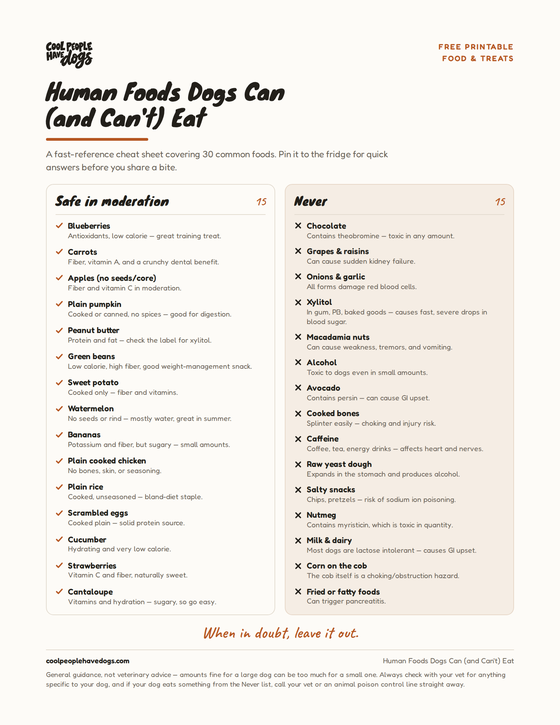
Grab the free human foods cheat sheet.
30+ common human foods sorted into safe, fine in moderation, and never — plus new guides as they publish.